
Black Pearl Oyster mushrooms: what the slate-grey caps mean and why they lighten as they mature
Black Pearl Oyster mushrooms start out with deep slate-grey caps that gradually lighten to a softer grey-brown as they mature. The colour change is completely normal and happens because the caps thin out and flatten as they grow, but colour alone is not the most reliable harvest signal. Cap shape tells you more about when to pick than colour does.
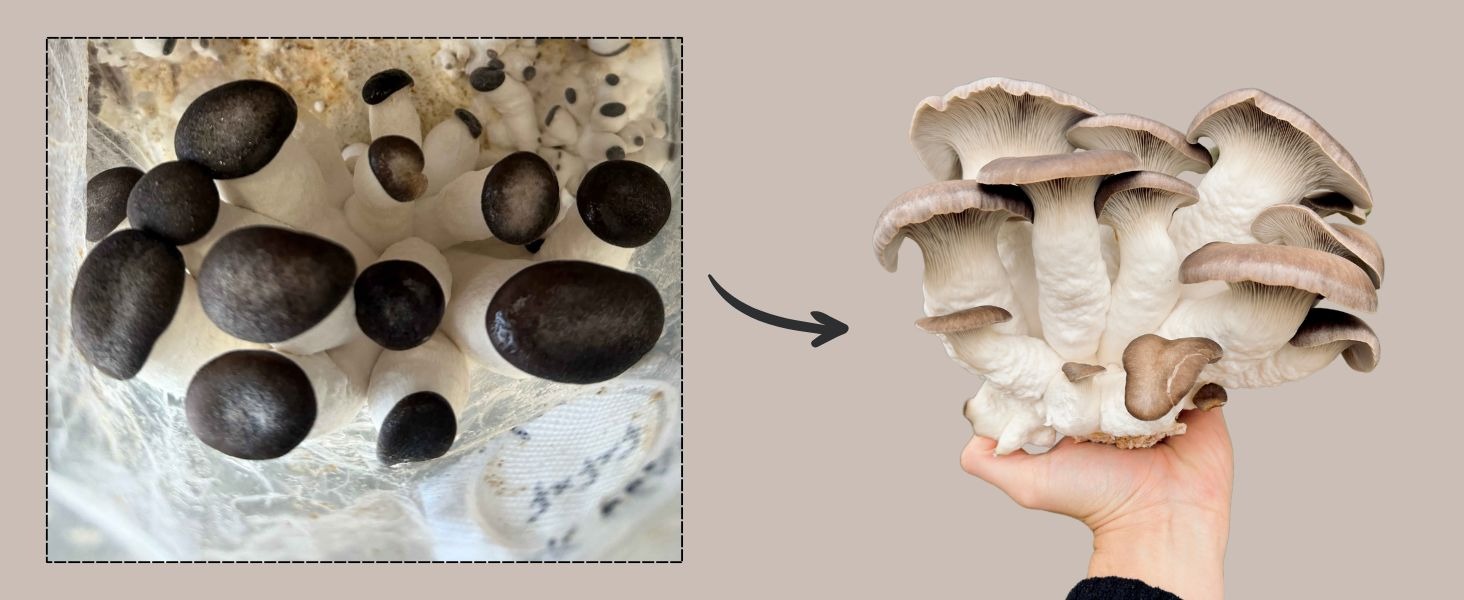
Black Pearl Oyster caps darken dramatically when young and lighten as they mature and flatten out.
Why Black Pearl caps are so dark in the first place
Black Pearl Oyster (Pleurotus ostreatus x eryngii) is a hybrid between a standard oyster mushroom and a King Oyster. The dramatic dark colouring is one of the traits inherited from the parent strains and one of the reasons the variety is prized by chefs and home cooks. When pins first appear on the log surface, they look almost black. As the caps expand into small, rounded buttons, the colour stays in that deep slate-grey to charcoal range.
The dark pigment is concentrated in the top layer of the cap. While the cap is small and curled (technically called "convex"), the pigment looks intense because the surface is compact and the layer is thick relative to the cap size. This is the stage where Black Pearl looks most dramatic and is often photographed for product images and recipe cards.
Why the caps lighten as they mature
As a Black Pearl mushroom matures, the cap goes through three changes at the same time. It expands outwards, it flattens, and the edges curl upwards. All three happen gradually over a few days, and all three contribute to the apparent colour change.
When the cap flattens, the same amount of dark pigment is now spread across a much larger surface area. The colour does not actually fade in the way a paint colour would. The pigmented layer just stretches thinner, which makes it look lighter to the eye. At the same time, the underside of the cap (where the gills are) is pale cream or off-white, and as the edges curl up, more of that pale underside becomes visible from above. The combined effect is a cap that looks noticeably lighter than it did 24 to 48 hours earlier.
Light exposure plays a small role too. Caps grown in brighter indirect light tend to hold their dark colour slightly longer than caps grown in dimmer corners. The difference is subtle and not worth chasing, but it explains why two clusters on the same log can look slightly different.
The four colour stages to recognise
Once you have grown a Black Pearl kit through one full flush, you will start to recognise the colour stages instinctively. Until then, here is what to look for at each phase.
Stage 1: Pin stage (almost black).
Tiny mushrooms just emerging from the log surface. The caps are barely formed and look like small black or charcoal-grey beads. This stage usually lasts 1 to 2 days. Do not touch or harvest. Keep misting and let them develop.
Stage 2: Button stage (deep slate-grey).
Caps are now visibly rounded and convex (curving downwards at the edges). Colour is at its darkest here, deep slate-grey to charcoal. This is the most photogenic stage but the mushrooms are still growing and have not reached full size. Harvesting now means smaller yields.
Stage 3: Mature stage (mid-grey, caps flattening).
Caps have expanded to their full diameter and are starting to flatten out. Colour is a softer mid-grey, sometimes with a slight brown tint. Edges are still relatively straight or only just beginning to lift. This is the ideal harvest window. The caps are at their largest, the texture is firm, and the flavour is at its peak.
Stage 4: Over-mature (light grey-brown, edges curled up).
Caps look noticeably paler, sometimes with a beige or tan tint. Edges have curled upwards into a shallow bowl shape, exposing the gills underneath. You may see a fine dusting of white or pale spore print on the log surface or on caps below. The mushrooms are still edible but the texture starts to soften and the flavour weakens. Harvest immediately if you reach this stage.
Why cap shape is a more reliable harvest signal than colour
Colour gives you a rough idea of where the mushroom is in its lifecycle, but it is not precise enough to use as a harvest cue on its own. Two clusters on the same log can sit at different colour intensities depending on their position, the light they receive, and how thick the original pin was. Cap shape, on the other hand, is consistent. Every Black Pearl mushroom moves through the same shape changes in the same order, and those changes correlate directly with texture and flavour.
Here is what to look at when deciding whether to harvest. First, check the edges of the cap. If they are still curving downwards or sitting flat, the mushroom is still growing. If they are starting to lift and turn upwards, you are at peak harvest. If they have curled into a clear bowl shape, you have waited slightly too long. Second, look at the overall cap profile from the side. A young cap looks like a small dome. A peak-harvest cap looks like a flat plate or a very shallow saucer. An over-mature cap looks like a shallow bowl or umbrella turned inside out.
The reason this matters is that the texture and flavour of Black Pearl peak just before the caps fully flatten. If you wait for the colour to lighten dramatically, you have usually waited too long. The caps will still taste good, but the dense, meaty bite the variety is known for starts to soften, and you may also lose some weight to spore drop. For reference, check out our Black Pearl Oyster harvest timing guide.
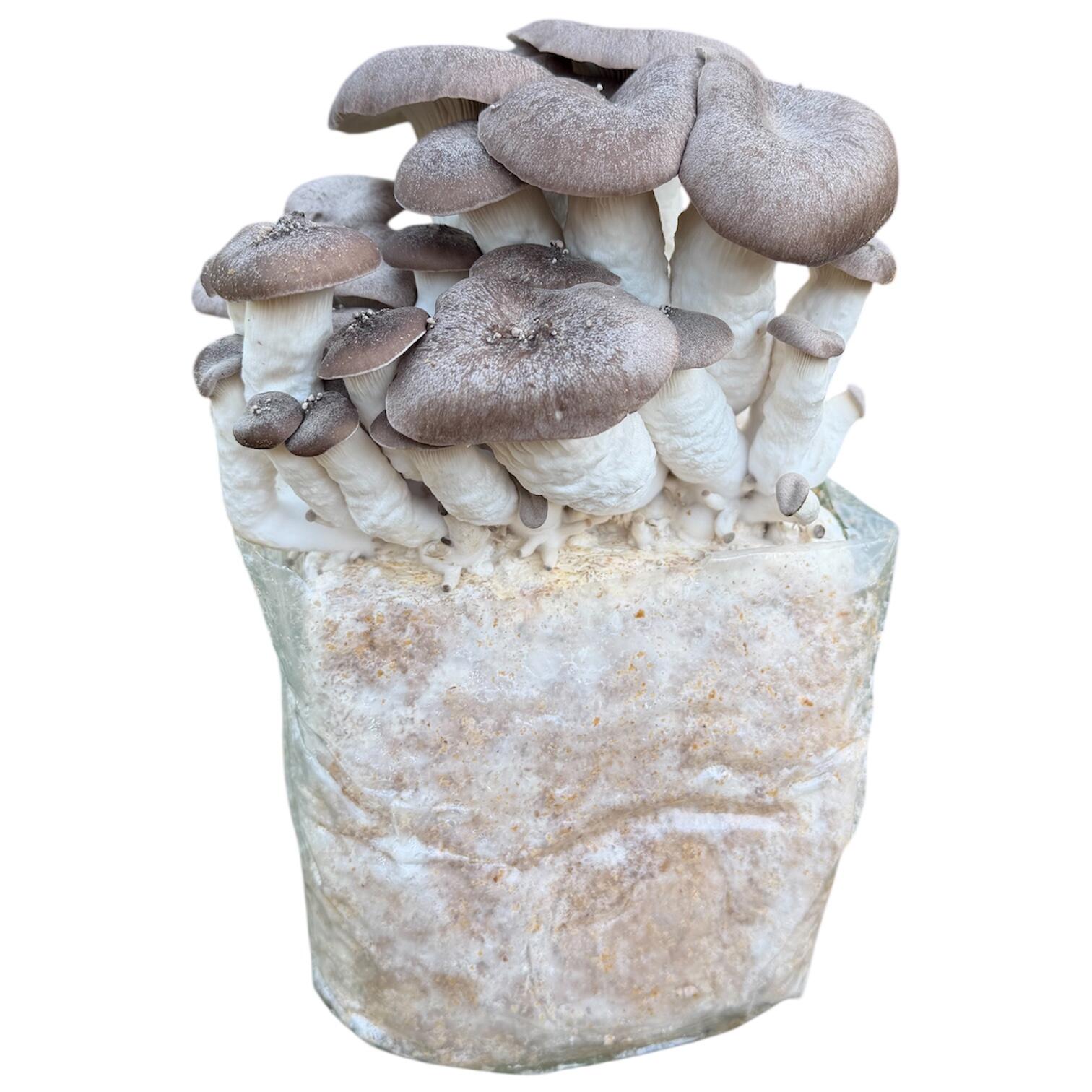
Peak harvest: caps fully expanded, mid-grey colouring, edges still relatively flat and not yet curled upwards.
Common questions about Black Pearl colour changes
My Black Pearl caps look brown rather than grey. Is something wrong?
Probably not. Mid-grey can look brownish under warm indoor lighting, especially under traditional bulbs or yellow-toned LEDs. Take the kit to a window in natural daylight and check again. If the caps look grey in daylight, they are fine. If they genuinely look brown across the whole cluster (rather than just under one type of light), it usually means they are at the late mature stage and ready to harvest now.
One cluster is darker than the others. Should I do something different?
No, this is normal. Clusters that started later or are positioned in a slightly cooler or darker spot on the log will lag behind the others by a day or two. They will catch up. Continue your normal misting routine and harvest each cluster when it reaches the peak shape, not all at once.
I see white powder on the caps below the cluster. What is it?
That is spore print, and it means the upper caps are mature and starting to release spores. Harvest now. Spore drop is not harmful but it does signal that the mushrooms are at the late end of their harvest window, and waiting any longer will start to affect texture.
The caps look pale right from the start. What does that mean?
If pins emerge looking pale grey rather than dark, it usually means the growing temperature is sitting at the warmer end of the range (above 19 degrees) or the room is unusually bright. Black Pearl produces its darkest pigment at 17 to 18 degrees in indirect light. Pale caps are not a problem and the mushrooms will still taste the same, but if you want the dramatic dark colouring, try a slightly cooler spot for the next flush.
Grow your own Black Pearl Oyster mushrooms
Our ready growing kit arrives as a fully colonised log. Just mist twice daily and watch the dramatic dark caps develop in 15 to 20 days.
Shop the Black Pearl Oyster KitFor a full visual guide to what each stage looks like, see the mushroom growing kit timeline. If you want to learn more about the variety itself before you decide, our kit comparison page covers all the oyster varieties side by side.
Published by Merryhill Mushrooms · Six-generation mushroom growers, Storrington, West Sussex