
How to Grow White Oyster Mushrooms at Home
White Oyster (Pleurotus ostreatus var. florida) is a clean, beginner-friendly oyster variety with bright ivory caps, a mild and clean savoury flavour, and a tender texture that holds up well in heat. Most UK shoppers recognise oyster mushrooms from supermarket shelves, usually the grey-capped strain, although the bright white variety is harder to find at retail. It's the oyster mushroom with the widest temperature tolerance in the Merryhill Mushrooms range, cropping reliably at 14 to 21°C year-round in most British homes.
The Merryhill Mushrooms White Oyster Mushroom Growing Kit arrives fully colonised and ready to fruit. The spawn run and colonisation are completed at the farm in Sussex before the kit ships, so your first harvest arrives 7 to 10 days after setup. Each kit produces 2 to 3 flushes across its growing life on a straw-based compost substrate.
White Oyster is also one of the few varieties available from Merryhill Mushrooms as both an indoor ready-growing kit and an outdoor log inoculation kit, making it a practical choice if you want both fast results and a longer-term garden project running at the same time.
What Makes White Oyster Different from Other Oyster Varieties
Pleurotus ostreatus var. florida is a white-capped strain of the broader Pleurotus ostreatus species, often sold commercially under the name "Pearl Oyster." The Florida variety produces distinctly brighter white caps than the common grey-brown ostreatus you find in supermarkets, and grows well across a wider temperature range. That range, 14 to 21°C with an ideal of 18 to 19°C, covers most UK homes throughout the year without any climate control.
Compared to Summer Oyster (Pleurotus pulmonarius), White Oyster performs at cooler temperatures and is the stronger choice for growing through autumn and winter. Compared to Pink Oyster (Pleurotus djamor), it is considerably less heat-sensitive and produces larger, meatier caps. The flavour is milder than both Pink and Black Pearl Oyster, making it the most versatile oyster for everyday cooking.
White Oyster is also one of the few oyster varieties suited to outdoor log cultivation in the UK climate. The species Pleurotus ostreatus grows naturally on British hardwood, although the bright-white var. florida form we use indoors is an American cultivar of that same species rather than a UK-native strain in its own right. More on the outdoor log option in the dedicated section below.
How to Set Up Your White Oyster Mushroom Growing Kit
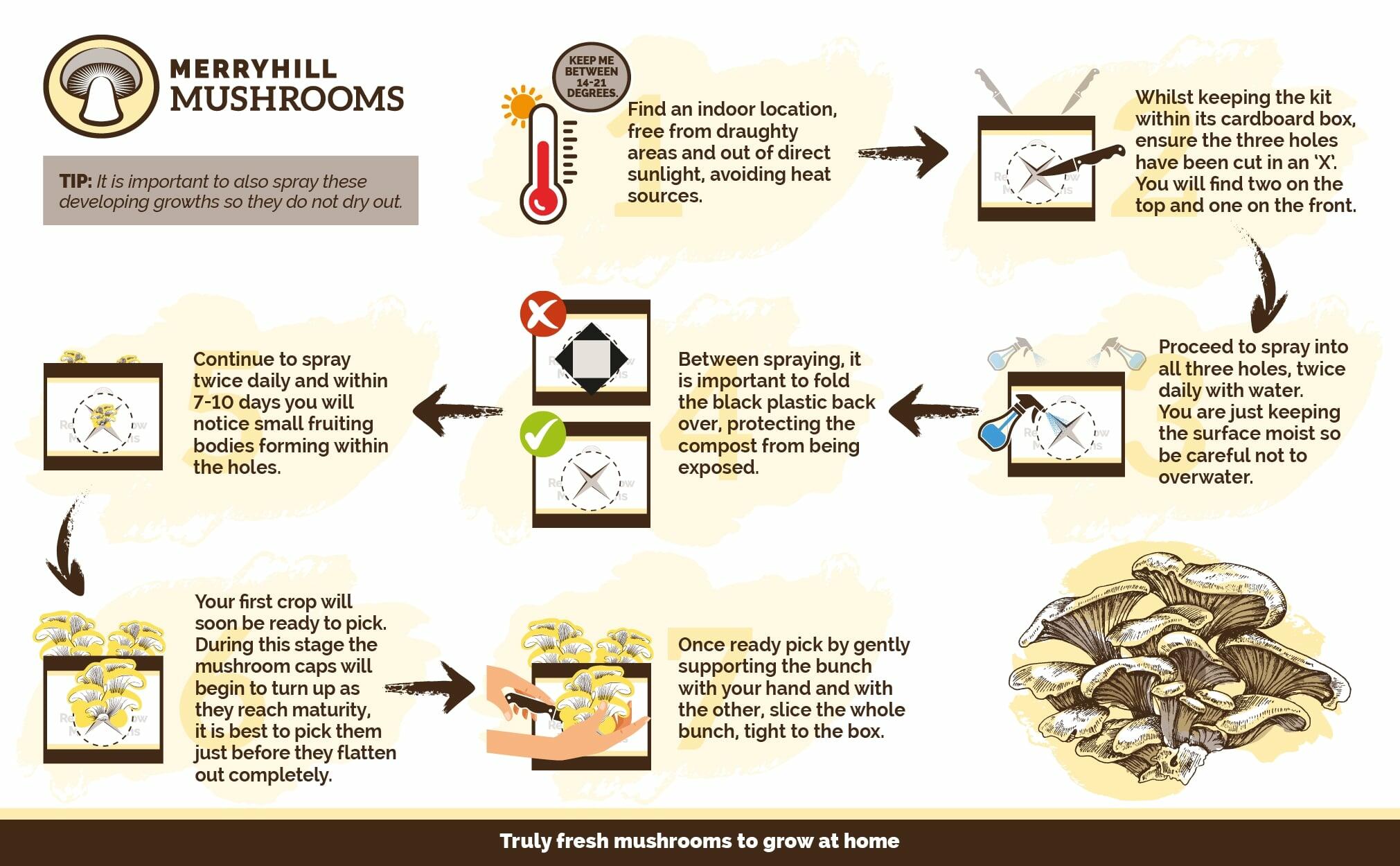
Setting up takes five minutes. Confirm all three holes are cut in an "X". Position the box in a room between 14-21°C away from direct sunlight, and start misting twice daily into the holes with a spray bottle. You're keeping the compost surface damp, not soaking it. Any pooling water between sessions should be dabbed away with paper towel.
The compost inside will look either brown (fresh straw substrate) or white (mature mycelium). Both are correct, depending on the kit's age on dispatch. Browse the full Merryhill Mushrooms kit range to compare White Oyster with other varieties. The White Oyster growing instruction guide is included with every kit, and the product support team is available if questions come up at any stage.
Pleurotus ostreatus, the broader species White Oyster belongs to, grows naturally on dead hardwood in UK woodlands. The straw-based compost in the kit replicates that substrate and compresses the process from months to days. Each 7x7x7 inch kit contains enough nutrition for 2 to 3 harvests across its growing life.
Step One - Setup
Take the box and confirm all three holes are cut in an "X". Position indoors, out of direct sunlight, in a room between 14-21°C. A kitchen shelf, living room sideboard, or a windowsill away from direct sun all work well.
The compost inside will appear brown (straw substrate) or white (established mycelium). Both are healthy. Start misting the three holes twice daily. You're maintaining surface moisture, not flooding the compost. Dab away any pooling water between sessions.
Avoid placing the kit near a radiator, in a sunny window, or in a room that drops significantly below 14°C overnight. Consistent temperature within the growing range makes a real difference to pinning speed and cluster quality.
Understanding the Stages of Compost Development
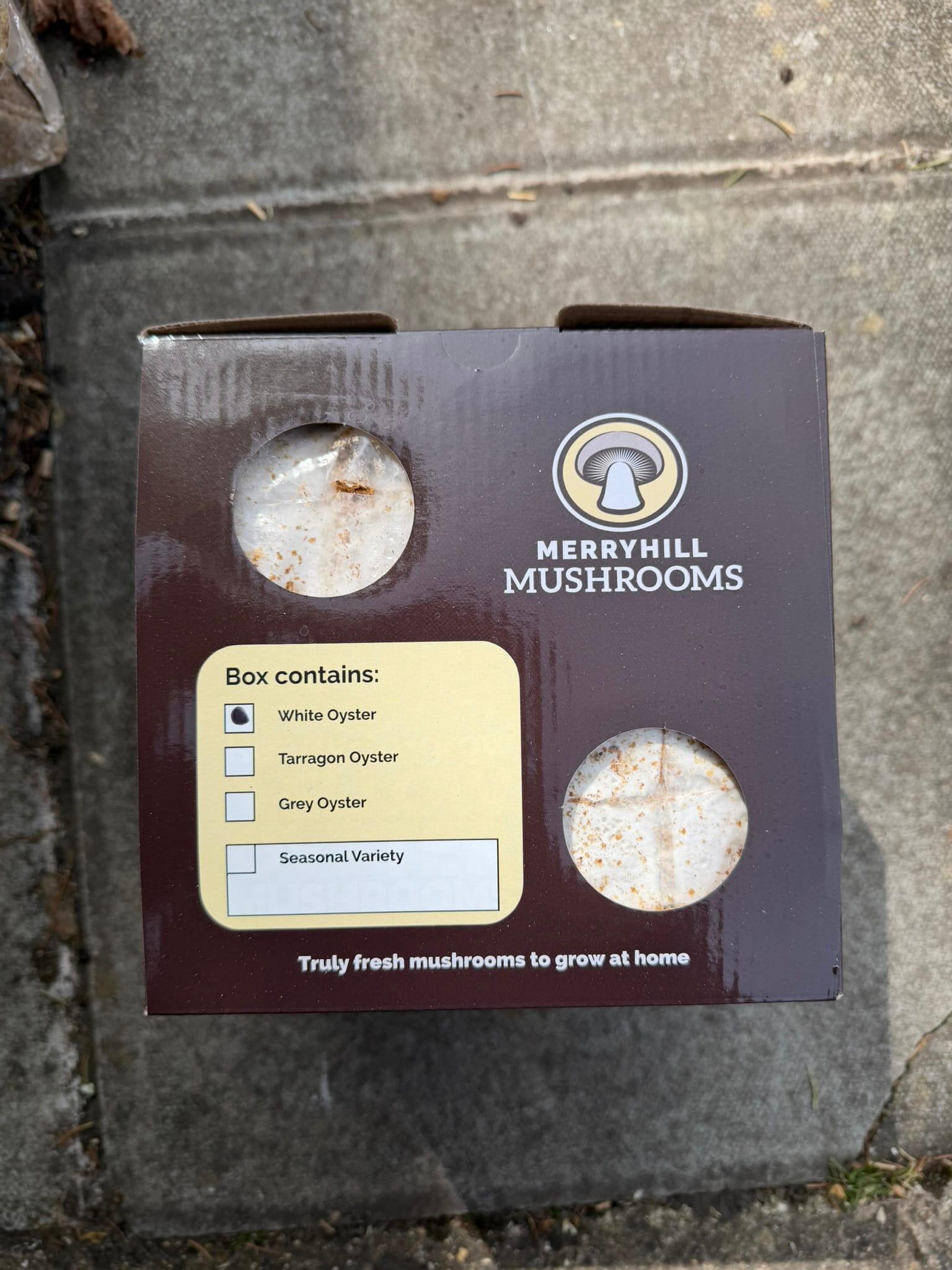
As the White Oyster mycelium grows through the straw-based compost, the substrate changes appearance. Fresh compost looks like pale brown straw. As the mycelium colonises the material, it transitions to a thick, bright white coverage across the surface. Mushroom fruit bodies develop from that white layer and push out through the growing holes.
White, cream, or beige growth at any stage is normal. If you see green, black, or pink patches in the compost itself (not on the mushrooms), that can indicate contamination. Contact the Merryhill Mushrooms product support team with a photo and they'll help identify what you're looking at.
White Oyster mycelium can occasionally become very dense and thick, forming a layer that prevents water from soaking in. If water sits on the surface rather than being absorbed, reduce your spray volume per session and dab away the excess. The Merryhill Mushrooms misting guide covers overgrown mycelium and overwatering in detail.
What to Expect: White Oyster Growth Day by Day
Every White Oyster kit develops at its own pace, depending on room temperature and humidity. At the ideal range of 18 to 19°C with twice-daily misting, first pins typically appear within 3 to 5 days of setup and first harvest arrives between day 7 and day 10. Cooler rooms within the 14 to 21°C range still produce results, just a few days later at each milestone.
Day 1 - Setup
Remove the kit from its postal box immediately on arrival. White mycelium or brown straw compost through the holes is normal. Position in a warm room with indirect light between 14 and 21°C and begin misting twice daily.
Day 3-5 - Pins Appear
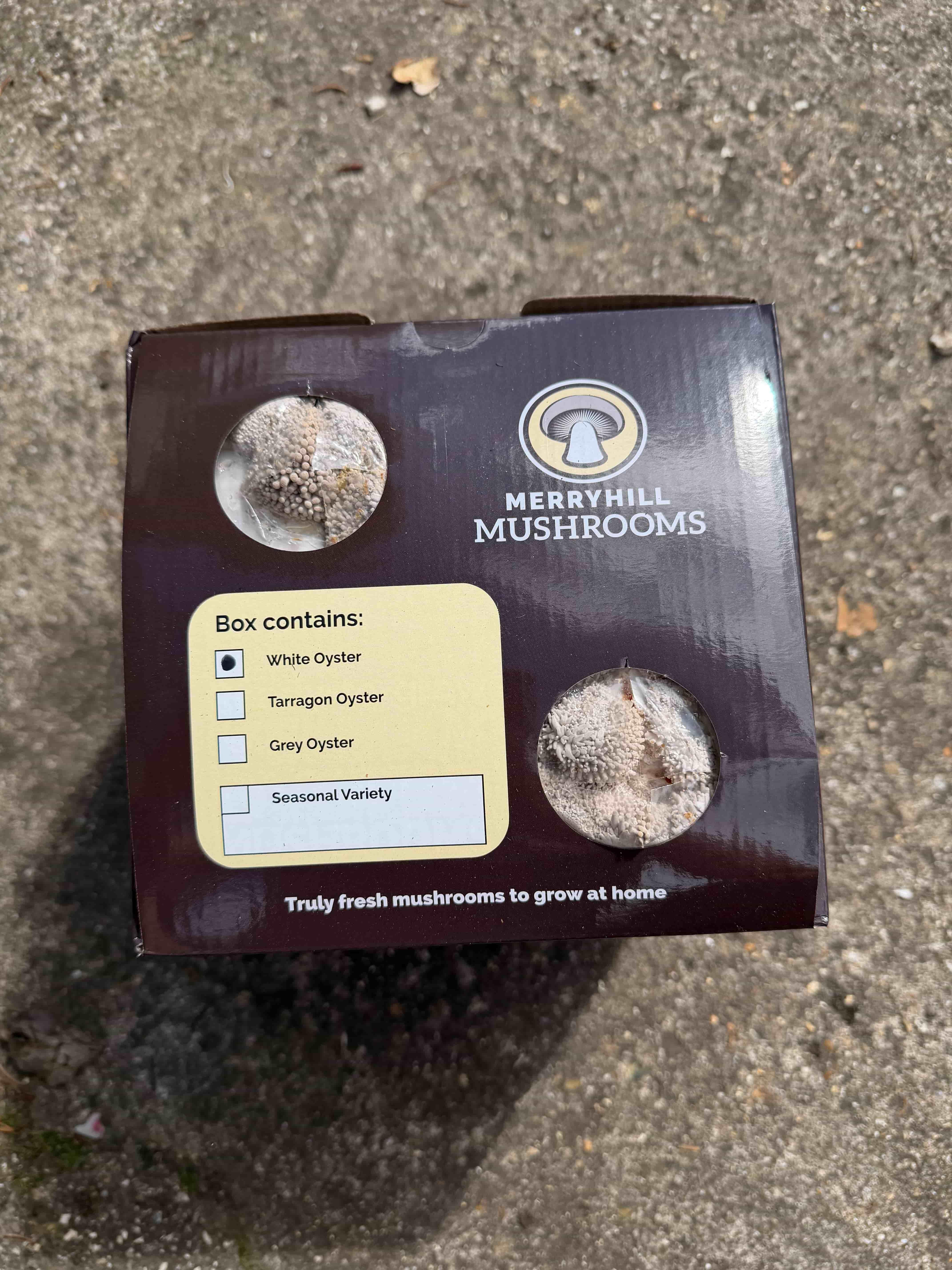
Small pale pin-heads begin forming around the cut holes as the mycelium starts fruiting. White Oyster pins can be subtle at first. Keep misting and growth often accelerates overnight once the surface has consistent humidity.
Day 5-7 - Clusters Expand
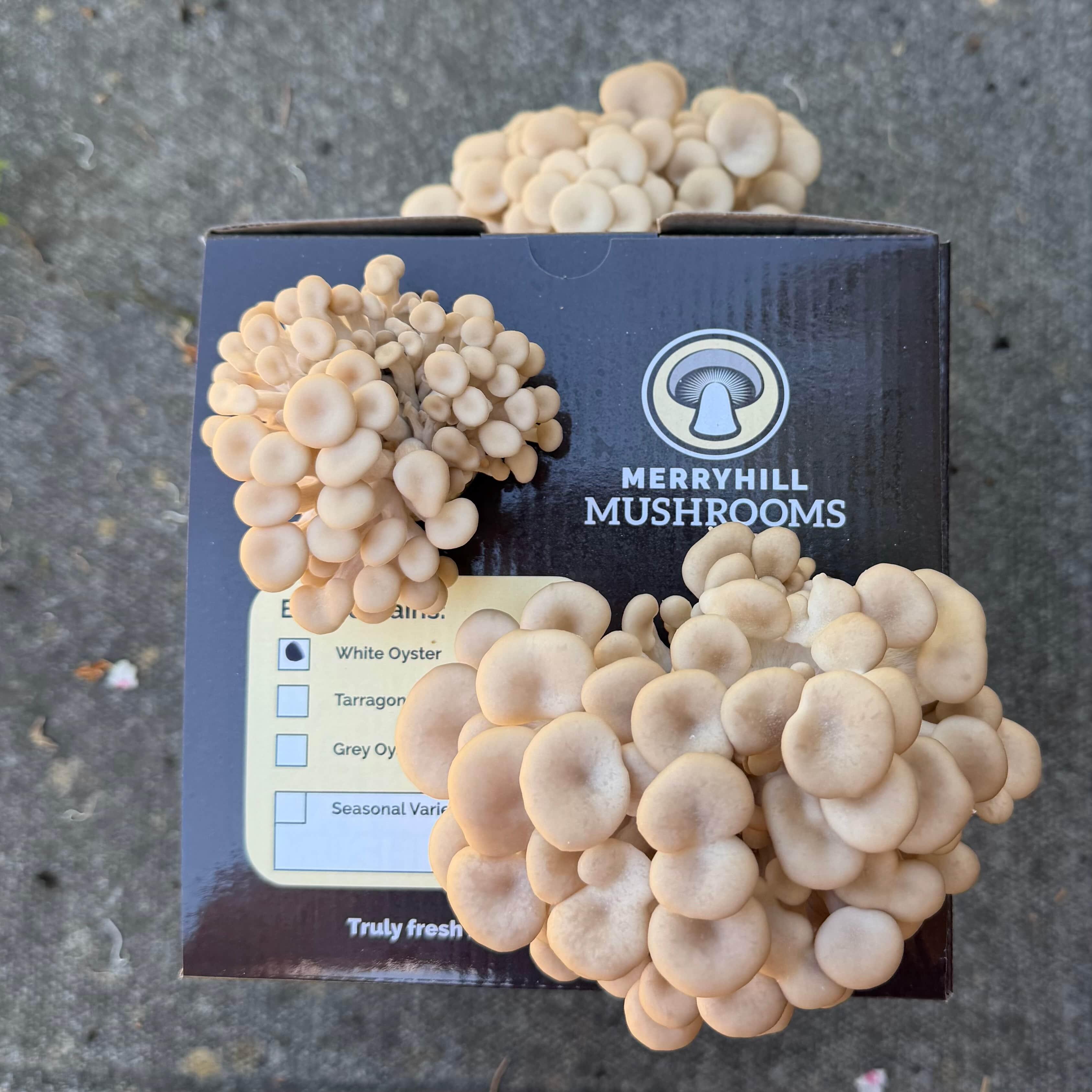
Pin-heads expand into the familiar oyster cap shape. Clusters push out of the holes and become clearly visible. The pale ivory colour is characteristic of this variety. Continue twice-daily misting.
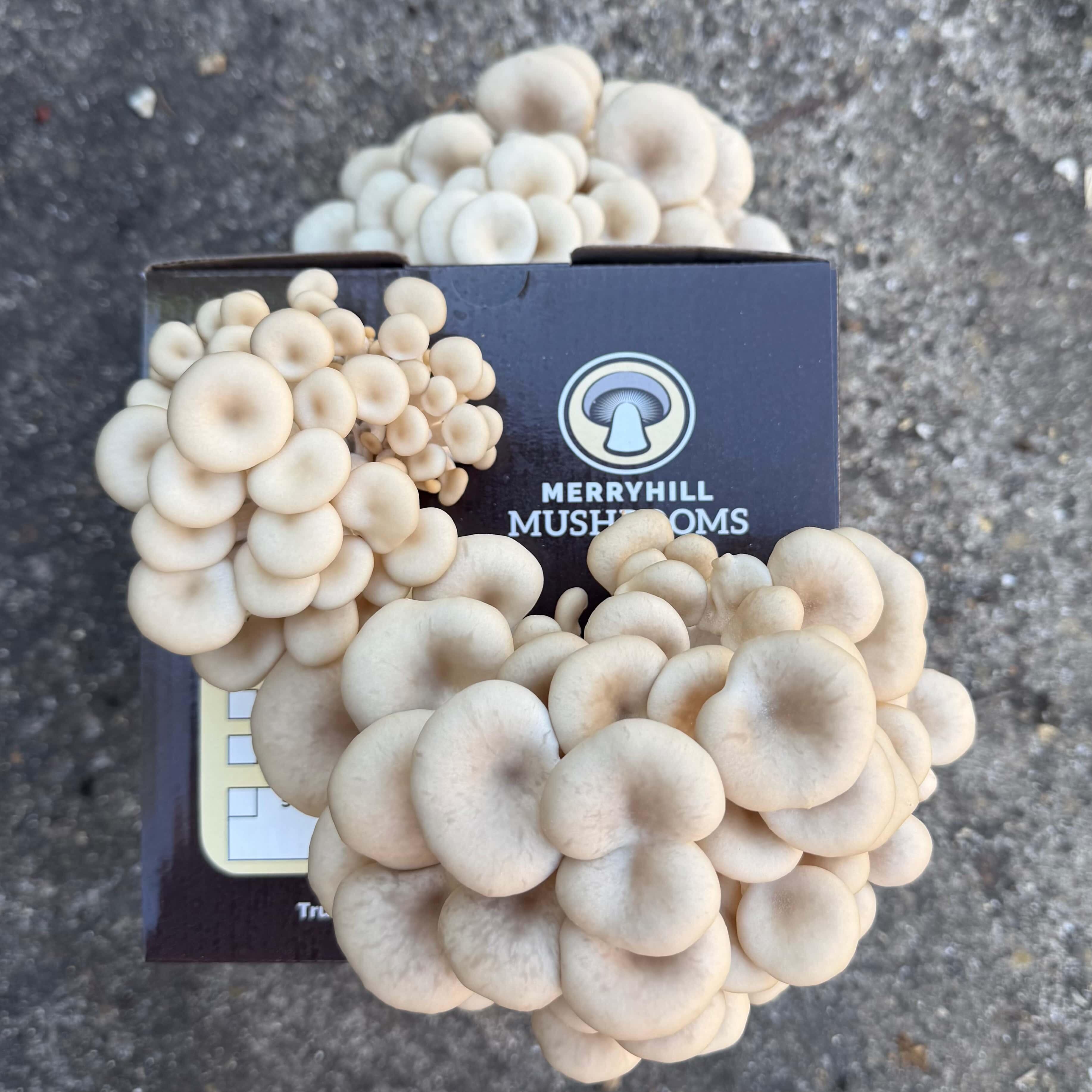
Day 7-8 - Approaching Harvest Size
Caps fill out and flatten. The cluster takes its final shape and the ivory colour deepens slightly. This is often the fastest-growing stage. Monitor daily so you catch the cluster before the cap edges begin curling upward.
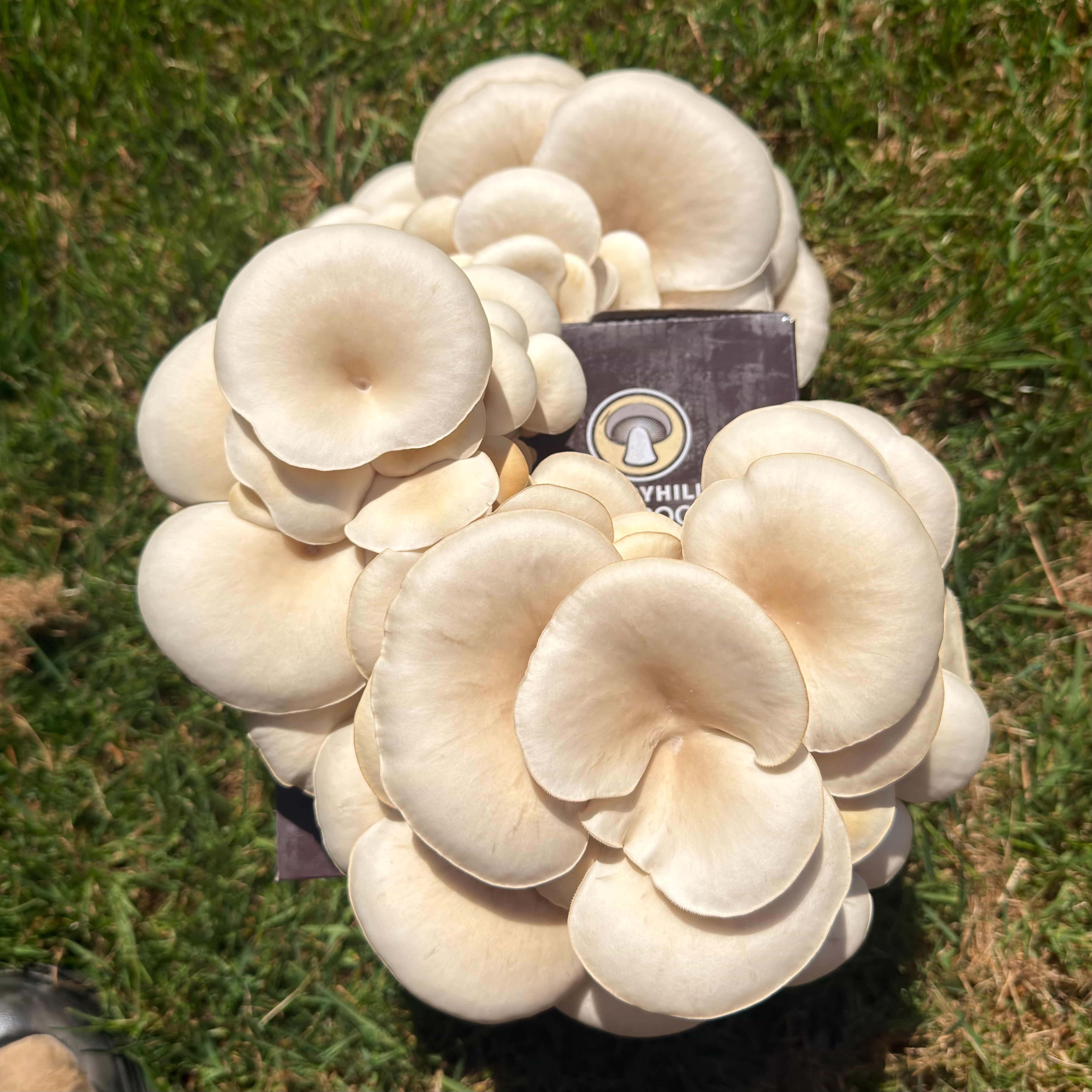
Day 7-10 - Harvest Time
Harvest when caps have fully opened and flattened but before edges curl upward. Fine white dust on the box means spores are dropping. Pick promptly at that point. Twist the entire cluster at the base cleanly away from the kit.
Timelines are typical results at 14-21°C with regular misting. View the full growing timeline with all varieties and real photos at each stage
Temperature, Humidity, and Fresh Air: What Controls Your Yield
Growing Tips
Mist twice daily to keep the holes consistently damp. Keep room temperature between 18-19°C for best results, though the kit grows reliably across the full 14 to 21°C range. White Oyster needs good airflow around the kit to prevent CO2 build-up. If stems grow long and thin with small caps, that's a ventilation problem. Move the kit somewhere with better natural air movement.
Three variables control your White Oyster yield. Get all three right and you'll see fast, dense clusters. Neglect one and the mushrooms will tell you.
Temperature. White Oyster grows between 14 and 21°C. The ideal range is 18 to 19°C, which produces the fastest pinning and most developed caps. Below 14°C, growth slows significantly. Above 21°C, pins can fail to form. Most UK homes fall naturally within the working range year-round, which is one of the practical strengths of this variety over heat-sensitive species like Pink Oyster.
Humidity. Twice-daily misting into the growing holes throughout the kit's life. Keep the exposed compost surface damp but not saturated. If you're unsure whether you're applying the right amount, the Merryhill Mushrooms misting guide explains the difference and covers the most common overwatering mistake with White Oyster: dense mycelium forming a layer that prevents water soaking in.
Fresh air exchange. CO2 accumulates around the holes when ventilation is poor. The mushrooms respond by producing long, thin stems with small underdeveloped caps rather than broad, meaty clusters. Position the kit in a room where air moves naturally. Avoid sealed cupboards or tight corners against a wall. The fresh air exchange guide explains the biology and gives practical fixes if you're seeing stem elongation.
Step Two - Pinning
White Oyster is a fast cropper. At 18 to 19°C, small pale pin-heads begin forming around the cut holes within 3 to 5 days of setup. Once pinning starts, growth accelerates quickly. Clusters that are small in the morning can be noticeably larger by that evening under good conditions.
Not all three holes will necessarily fruit at the same time. That's normal. The kit diverts nutrition to wherever conditions are most favourable. Keep misting all three holes and harvest each cluster as it reaches the right size, rather than waiting for all holes to catch up. If no pins appear after 7 days at the correct temperature, the Merryhill Mushrooms oyster troubleshooting guide covers the most common causes.
Handy Growing Guide
Fruiting and Harvesting Summary
White Oyster grows in clusters with clean ivory to pale cream caps. Maintain twice-daily misting and keep air circulating around the kit. Harvest by gripping the cluster at the base and twisting it cleanly away from the kit. If you notice elongated stems with small caps, the kit needs more fresh air. Move it to a better-ventilated spot and the next flush should produce wider, meatier clusters. Continue misting after each harvest and the next flush follows in 1 to 2 weeks.
Step Three - Fruiting and Harvesting
Within 7 to 10 days, clusters will be pushing out of the holes and approaching harvest size. White Oyster always fruits in clusters. That's normal and expected. A typical first flush produces one or more good-sized clusters per hole, though not all three holes will produce simultaneously.
The whole fruit body is edible apart from the very base of the stem, closest to the compost. For White Oyster recipes, visit the Merryhill Mushrooms recipe blog.
Pick when the caps have fully opened and flattened, but before the edges curl upward. White dust on the box surface means spores are dropping. The mushrooms are still safe to eat at that point, but pick them without delay. Leaving them past spore-drop doesn't add weight or size. It makes the texture brittle and shortens fridge life. Once harvested, White Oyster keeps in the fridge for up to a week, stored wrapped in a damp paper towel inside an open paper bag.
How and When to Harvest White Oyster Mushrooms
Harvest when the caps have fully opened and flattened, the cluster is dense, and the cap edges are still flat or only just beginning to wave outward. That's the peak harvest window. Grip the entire cluster firmly at the base and twist it away from the kit in one clean movement. White Oyster releases without a knife in most cases. If any material stays stuck to the box, trim it away. Discard only the root end. Stems and caps are both fully edible.
After each harvest, keep misting twice daily into the holes. The next flush typically follows in 1 to 2 weeks. Most Merryhill Mushrooms White Oyster kits produce 2 to 3 flushes across their growing life, with the first flush usually being the largest. The Merryhill Mushrooms yield comparison guide shows expected output flush by flush across all kit varieties.
Once the kit stops producing, the spent straw compost is peat-free and rich in organic matter. It works well as a garden soil amendment or compost addition rather than going in the bin.
Growing White Oyster Mushrooms Outdoors on Logs
White Oyster is one of the best oyster varieties for outdoor log cultivation in the UK. Pleurotus ostreatus, the parent species, naturally grows on British hardwood trees including oak, beech, birch, and ash. The var. florida we use for the indoor kits is an American cultivar of that same species, so the species itself is well established in the UK climate even though the bright-white Florida variety is a cultivated form rather than a wild British strain.
The Merryhill Mushrooms outdoor log inoculation kit includes 30 White Oyster spawn plugs and beeswax to seal the holes. You drill an 8mm drill bit into a freshly cut hardwood log, hammer in the spawn plugs in a diamond pattern, and seal each hole with melted beeswax. The log then colonises over 12 to 18 months before producing its first flush after rainfall.
Once established, an inoculated log will fruit for three to five years with almost no ongoing care. No misting, no temperature monitoring, no equipment beyond the initial setup. For full step-by-step instructions, the outdoor log growing guide covers log selection, inoculation technique, and what to expect at each stage.
The indoor ready-growing kit and the outdoor log kit serve different purposes and work well alongside each other. The indoor kit delivers fresh mushrooms in a week. The log kit is a longer investment that eventually fruits on its own schedule after autumn and spring rainfall, for years.
Nutritional Profile of White Oyster Mushrooms
White Oyster (Pleurotus ostreatus var. florida) is low in calories and delivers a solid nutritional return per serving. A 100g portion provides approximately 33 kcal with around 3.3g of protein, negligible fat, and roughly 2g of dietary fibre. Mushrooms picked and cooked within hours retain more of their nutritional value than supermarket stock that has been in transit and cold storage for days.
Cooking with White Oyster Mushrooms
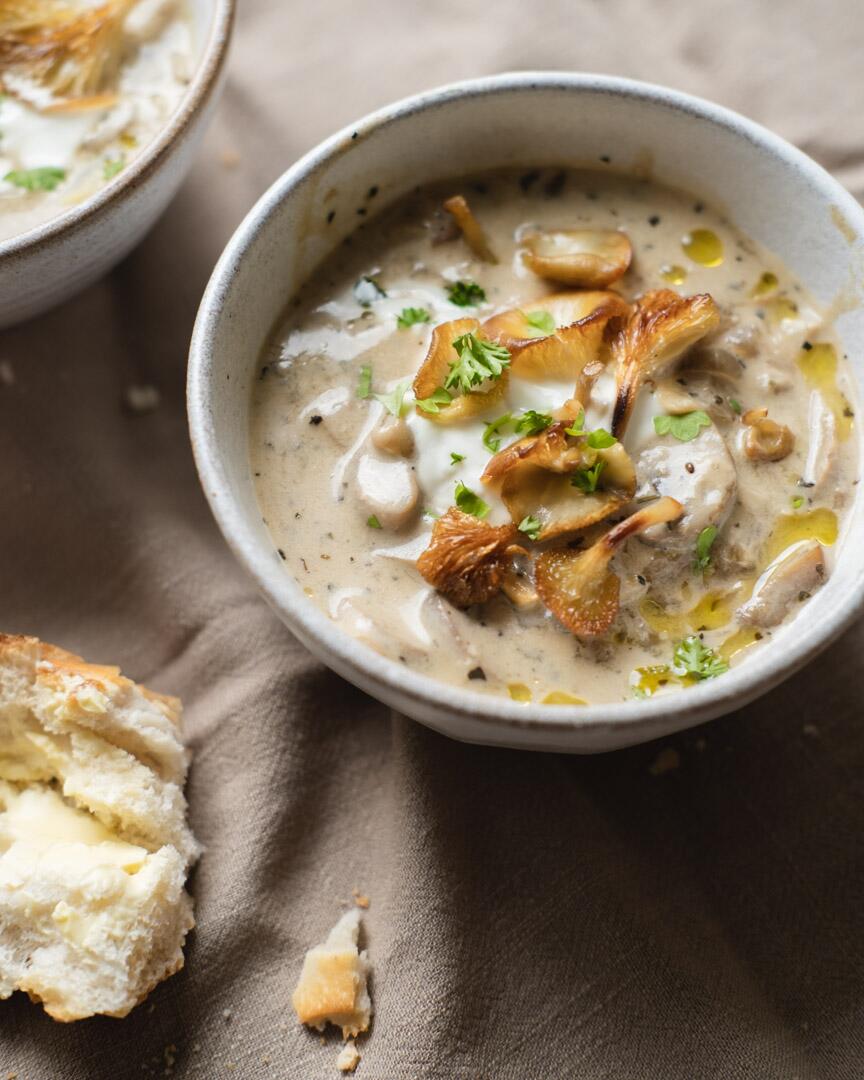
The flavour is clean and mildly savoury with very little of the earthiness found in common supermarket mushrooms. The texture is tender but holds its shape under heat. Pan-frying in butter or oil over medium-high heat produces golden, slightly crisp edges and develops a natural umami depth. That combination makes White Oyster one of the most flexible mushrooms in the kitchen.
The ivory caps hold their pale colour during light cooking better than most oyster varieties, which makes them visually clean in cream sauces, omelettes, and light pasta dishes. They also work in stir-fries with garlic and ginger, miso soups, risottos, and as a simple side with grilled fish or chicken. Tear or slice the clusters rather than chopping finely, and trim only the very base of the stem. Don't soak in water before cooking as oyster mushrooms absorb moisture quickly and will steam rather than sear if they go into the pan wet.
For technique across all oyster varieties, the Merryhill Mushrooms oyster mushroom cooking guide covers heat, timing, and seasoning in detail. Additional White Oyster recipes are in the Merryhill Mushrooms recipe blog.
Frequently Asked Questions
At 18 to 19°C with twice-daily misting, first pins appear within 3 to 5 days and first harvest arrives between day 7 and day 10. Cooler rooms within the 14 to 21°C range still produce results, just a few days later. Second and third flushes each take around 1 to 2 weeks after the previous harvest.
Between 14 and 21°C, with 18 to 19°C producing the fastest and most consistent results. White Oyster's wide temperature tolerance makes it the most reliable choice for year-round growing in UK homes, as most kitchens and living rooms fall naturally within that range without any adjustment.
Long, thin stems with small caps almost always indicate insufficient fresh air exchange. CO2 builds up around the holes in poorly ventilated spaces and the mushrooms produce elongated growth rather than broad caps. Move the kit to a room with better natural airflow. The Merryhill Mushrooms oyster kit growth guide covers this and other common variations.
Pearl Oyster is a broad common name for the Pleurotus ostreatus species as a whole, which includes grey, brown, and white-capped strains. The Merryhill Mushrooms White Oyster kit uses Pleurotus ostreatus var. florida, which produces bright white caps and grows well at moderate UK indoor temperatures. If a recipe calls for pearl oyster, White Oyster is the right substitute.
Two to three flushes across 3 to 4 weeks. The first flush is normally the largest. After each harvest, continue misting twice daily and the next flush follows in 1 to 2 weeks. Once the kit is spent, the straw compost is peat-free and works well as a garden soil amendment.
Yes. Pleurotus ostreatus, the parent species of our White Oyster (var. florida), naturally grows on British hardwoods, so the species is well suited to outdoor log cultivation in the UK climate. The Merryhill Mushrooms outdoor log inoculation kit includes White Oyster spawn plugs. The log takes 12 to 18 months to colonise but then fruits after rainfall for three to five years.
In the fridge, wrapped in a damp paper towel inside an open paper bag. Good condition for up to a week. Don't use sealed plastic bags or containers, which trap moisture and accelerate deterioration. Clean just before cooking rather than before storing.
Completely normal. The kit naturally directs nutrition to whichever holes have the most favourable conditions. Growing from fewer holes just produces larger individual clusters rather than reducing total yield. Harvest each cluster when it's ready. Don't wait for the other holes to catch up first.