Home-Grown vs Shop-Bought Enoki: Why the Supermarket Pack is Not the Same Product
Home-Grown vs Shop-Bought Enoki: Why the Supermarket Pack is Not the Same Product
Food miles, plastic wrap, and the freshness gap that most UK shoppers do not know about.
Shop-bought enoki in UK supermarkets is almost entirely imported from East Asia, packed in sealed plastic, and several days to several weeks old by the time it reaches your kitchen. Home-grown enoki from a kit is harvested minutes before cooking, needs no packaging, and gives you access to varieties that UK shops rarely stock. The difference in texture, aroma, and freshness is genuinely noticeable.
Quick answer
Supermarket enoki is imported, plastic-wrapped, and days to weeks old. Home-grown enoki from a kit is fresh, unpackaged, and gives you the choice between White and Golden varieties. Supermarkets almost exclusively stock White Enoki, so if you want Golden Enoki, growing is the practical route.
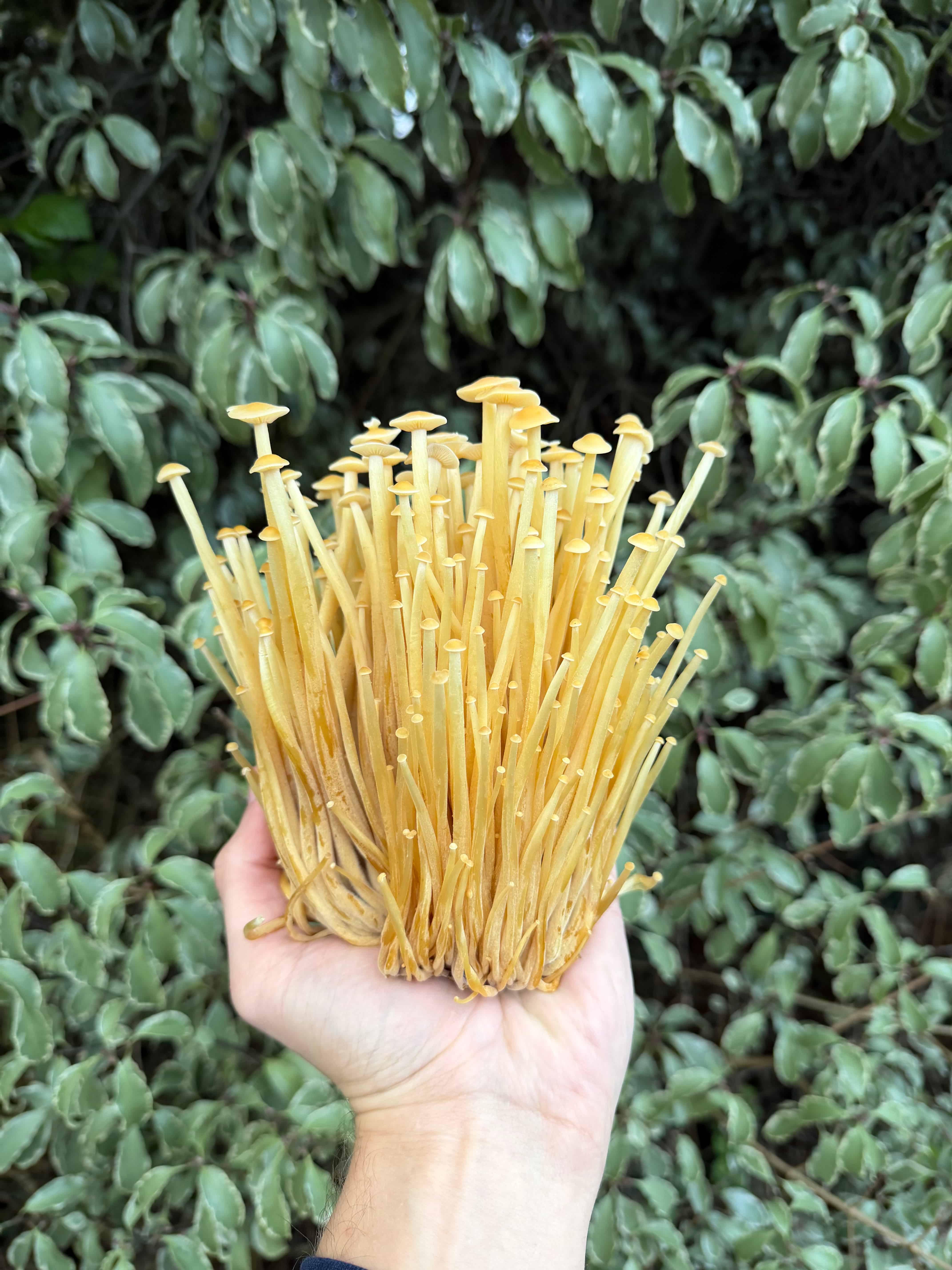
Home-grown enoki, harvested the same day. The difference from a supermarket pack is immediately visible.
Where shop-bought enoki actually comes from
If you pick up a pack of fresh enoki from a UK supermarket or Asian grocer, the odds are overwhelming that it was grown in China, South Korea, or Japan. Commercial enoki cultivation is concentrated in East Asia, where industrial growing facilities produce the uniform white clusters you see on shelves. The product is harvested, packed, chilled, and shipped thousands of miles to reach UK distribution centres.
By the time a pack arrives at your local supermarket, it has typically been in the supply chain for a week or more. Add a few days on the shelf and a few days in your fridge, and the enoki you eat is often two to three weeks from harvest. Mushrooms are living organisms that continue to degrade after picking. They do not arrive at the supermarket in the same state they left the growing facility.
A home-grown enoki kit sidesteps the entire import chain. The kit fruits on your kitchen counter, you harvest when the clusters are ready, and the gap between harvest and cooking is measured in minutes rather than weeks.
The plastic packaging problem
Every pack of supermarket enoki you have ever bought has been sealed in plastic. There is no fresh-loose enoki option in UK retail, and for a reason: the product would not survive the transit and shelf life without a sealed wrapper. The packaging is part of what makes long-haul import possible.
The problem is that sealed plastic also traps moisture against the strands throughout transit and storage. This is one of the main reasons shop-bought enoki so often arrives slightly damp, and why it can develop a slimy surface within a day or two of opening. The plastic that keeps it alive during transport is also what degrades its texture. If you have ever bought a pack of enoki and found it disappointingly limp or wet, the packaging is the main culprit. It can also be prone to listeria.
Home-grown enoki needs no packaging at all. You harvest directly from the kit into the pan, or into a paper-lined container if you are keeping some for the next day. No plastic, no condensation, no sliming.
Why home-grown enoki feels different in the pan
Fresh-harvested enoki holds its firmness in the pan, browns properly rather than steaming, and releases far less water during cooking. Shop-bought enoki that has been plastic-wrapped for weeks tends to go limp quickly and produces noticeably more liquid, which is why so many home cooks struggle with watery stir-fries. The mushroom is not the problem. The supply chain is.
Variety availability: White vs Golden Enoki
UK supermarkets almost exclusively stock White Enoki. Even larger Asian supermarkets rarely carry the Golden variety as a fresh product, and when they do, it is inconsistent and often seasonal. For most UK shoppers, Golden Enoki is effectively unavailable in any shop.
Growing at home gives you access to both varieties without compromise. Our Enoki growing kit produces the familiar white-stemmed clusters, and our Golden Enoki growing kit produces the honey-gold variety that is almost impossible to find fresh in UK retail. Both kits are ready-growing, which means the mycelium is already established and all you need to do is follow the basic care routine on the packaging.
A small point of interest on the Golden Enoki kit: the species we grow for it, Flammulina velutipes, is the same mushroom that fruits wild in British woodland through the winter months, where it is known as Velvet Shank. So while the commercial white enoki you find in shops is a different cultivated species from East Asia, our Golden Enoki kit grows a species with genuine British heritage. If you are interested in the differences between the two varieties, we have a detailed guide on White Enoki vs Golden Enoki that covers flavour, texture, and cooking differences.
Freshness and flavour: what the gap actually feels like
The honest answer is that most people who have only cooked shop-bought enoki do not know what fresh enoki is supposed to taste like. The mild, slightly fruity aroma that home-grown clusters have when you first snap one open is largely absent from supermarket packs, because volatile flavour compounds degrade quickly after harvest.
The texture difference is the bigger one. Fresh-harvested enoki is firm and has a pleasant bite that holds up through stir-frying, grilling, or wrapping. Shop-bought enoki that has been in plastic for weeks is softer, more watery, and less able to take a sear. If you have ever wondered why restaurant enoki dishes seem to have so much more character than your home attempts, freshness is usually the reason.
Growing your own will not transform you into a professional chef, but it does remove the single biggest limiting factor in how good your enoki dishes can be.
Cost per pack vs cost per kit
A supermarket pack of fresh enoki typically costs between £1.50 and £3.00 depending on the store and weight. An Enoki growing kit costs more upfront, but it produces fresher, higher quality flushes over its lifetime, we will never compete on supermarket imports on price, but we will always win on taste and freshness, plus the ability to grow your own mushrooms is always fufilling.
If you only cook enoki once or twice a year, or need it immediately for use, the supermarket is probably the sensible choice. If you cook with enoki regularly, or if you want access to Golden Enoki, or if you simply value the freshness and environmental side of growing your own food, a kit makes the stronger case.
Grow fresh enoki on your kitchen counter
Our ready-growing Enoki and Golden Enoki kits arrive already colonised and fruit in a couple of weeks. No supply chain, no plastic, no food miles.
Browse growing kitsThe environmental side
Food miles are not the only environmental consideration, but for a fresh perishable product shipped from East Asia, they are a meaningful one. A pack of supermarket enoki has typically travelled somewhere between five and six thousand miles to reach a UK shelf, most of that by refrigerated sea or air freight. Add the plastic packaging that gets binned after a single use, and the environmental footprint per meal is considerable.
A kit grown at home has none of that. The substrate block is biodegradable, there is no single-use plastic, and the food miles are effectively zero. For UK customers who care about where their food comes from, it is one of the simplest swaps you can make without changing what you cook.
When shop-bought still makes sense
It is worth being honest about this. If you need enoki tonight for a specific recipe and you do not already have a kit growing, the supermarket is your only option. Growing a kit takes around two to three weeks from setup to first harvest, so it is a planning choice rather than an emergency substitute. Many of our customers run both: they keep a kit on rotation on the counter for regular cooking, and rely on supermarket packs only when they need enoki at short notice.
Frequently asked questions
Where does most UK supermarket enoki come from?
The majority of fresh enoki sold in UK supermarkets is imported from East Asia, principally China, South Korea, and Japan. Commercial enoki cultivation is heavily concentrated in those countries, and the UK does not have a significant domestic commercial supply chain for the product.
Why is shop-bought enoki often slimy?
The plastic packaging traps moisture against the strands during transit and storage. Combined with the age of the product by the time it reaches the shelf, this is the main cause of the wet, slimy texture many people encounter. Home-grown enoki does not have this problem because it is not packaged.
Can I buy Golden Enoki in a UK supermarket?
Very rarely. UK supermarkets, including most Asian grocers, stock only White Enoki as a standard line. If you want Golden Enoki fresh, growing your own with a kit is the most practical route.
How long does an Enoki kit take to fruit?
Around two to three weeks from setting up the kit to the first harvest, depending on temperature and conditions. Enoki prefers slightly cooler temperatures than most mushroom kits, ideally 10 to 18°C, which suits UK kitchens through most of the year.
Does home-grown enoki really taste different?
Yes, noticeably so. The mild fruity aroma of fresh enoki is largely lost within a week or two of harvest, and the texture softens as the mushroom ages in its packaging. Most people who have only cooked shop-bought enoki are genuinely surprised by the difference the first time they cook a fresh-harvested batch.
What to do next
If you have never cooked with fresh enoki before and want to see what the fuss is about, a supermarket pack is a perfectly reasonable place to start. Our guide on how to prepare enoki mushrooms covers the trimming, separating, and portion basics that apply whether your enoki is shop-bought or home-grown.
If you already enjoy cooking with enoki and want to see what the mushroom is really capable of when fresh, our Enoki and Golden Enoki kits are the fastest way to close the gap between harvest and plate. You can also browse our full range of ready-growing mushroom kits if you want to explore other varieties alongside enoki.
Published by Merryhill Mushrooms, six generations of growers in Storrington, West Sussex.