
White Enoki vs Golden Enoki: Two Species, Not One
White Enoki vs Golden Enoki: Two Species, Not One
The 2018 DNA study that split the world's most popular cultivated mushroom into two separate species, and what it means when you choose a growing kit.
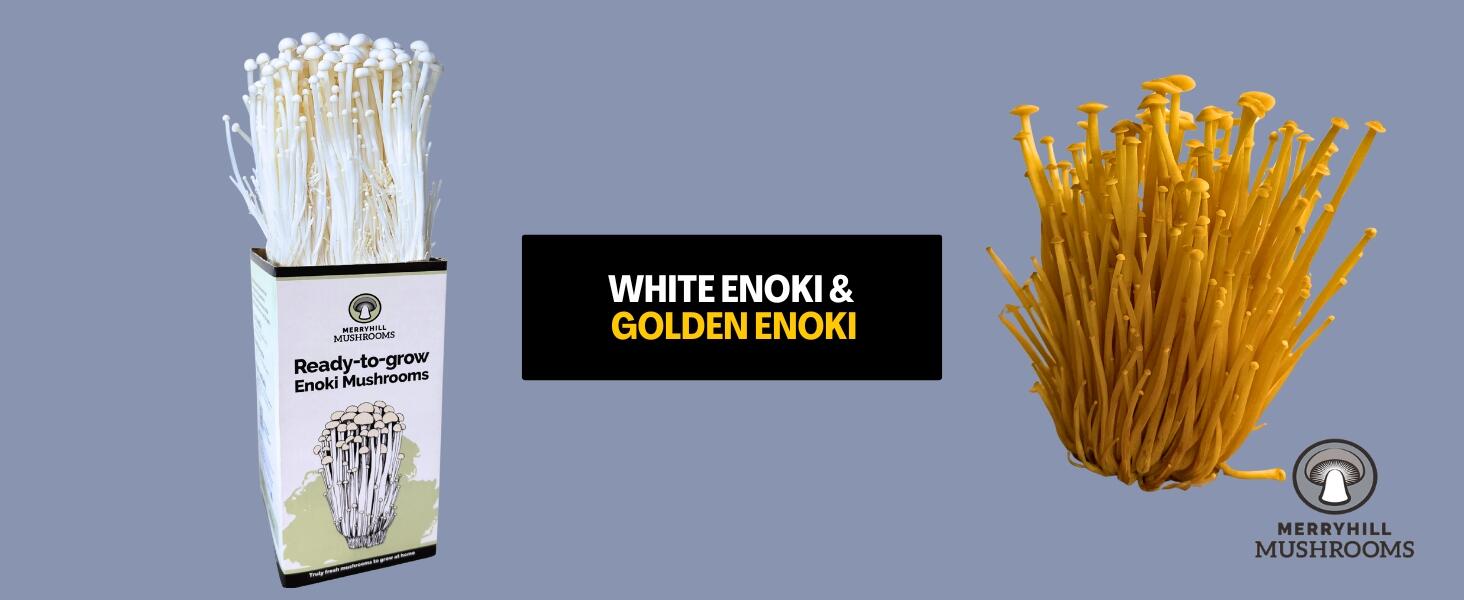
White Enoki and Golden Enoki are two genuinely separate mushroom species, not colour variants of the same one. White Enoki is Flammulina filiformis, a species native to East Asia that has been cultivated in China for over a thousand years. Golden Enoki is Flammulina velutipes, a species native to the UK and the rest of Europe, commonly known in British foraging circles as Velvet Shank. Until 2018 they were both classified as Flammulina velutipes, but DNA sequencing showed the Asian cultivated form was different enough to warrant its own species name.
This matters more than it sounds. The split changes how the two kits should be thought of: one as an indoor-only introduction from Asia, the other as a native British winter mushroom you can legally grow outdoors on logs. Below, a plain-English walkthrough of the science, the history, and what the distinction means when you are choosing between our White Enoki Growing Kit and our Golden Enoki Growing Kit.
Quick takeaways
- White Enoki (Flammulina filiformis) is an Asian species, cultivated in China since around 800 AD.
- Golden Enoki (Flammulina velutipes) is a UK and European native, widely known in British foraging circles as Velvet Shank.
- The two species were formally separated in 2018 after DNA sequencing showed they were distinct.
- Both grow as tight clusters of long stems in cultivation, but wild Golden Enoki looks completely different (orange caps, short stems) because it is exposed to light.
- Golden Enoki is the only one of the two we offer as an outdoor log inoculation kit, because it is native to the UK.
Why were White and Golden Enoki classified as one species for so long?
White and Golden Enoki were classified as a single species for most of modern mycology because they looked similar enough under a microscope and share the same genus. The species was originally described in the mid-1800s by the American mycologist Moses Ashley Curtis as Agaricus velutipes, then moved to the genus Flammulina by Rolf Singer in 1947. For the next seventy years, the same name covered the mushroom fruiting on British elm stumps in January and the white-stemmed bunches sold in Japanese supermarkets.
The confusion was understandable. Both species grow in tight clusters on dead hardwood. Both are saprotrophs, meaning they break down decaying wood. Both fruit in cool conditions, which is why Velvet Shank is also called the Winter Mushroom. And both have a velvety-feeling stem base, which is where the Latin name velutipes (meaning "velvety foot") comes from.
The cultivation technique used for commercial Enoki also hid the differences. Cultivated Enoki is grown in complete darkness, which forces the mushrooms to stretch toward any trace of light. That is why the cultivated form looks so dramatically different from anything you would find in the wild: long thin white stems and tiny caps, rather than short chunky stems with bright orange caps. Put a pack of supermarket Enoki next to a photo of a wild Velvet Shank and most people would assume they were entirely unrelated mushrooms.
What did the 2018 DNA study actually find?
The 2018 DNA study found that the Asian and European forms were genetically distinct enough to be treated as separate species, ending the long-running assumption that they were the same mushroom grown under different conditions. Researchers compared multiple gene markers across collections from Europe, North America, and East Asia, and concluded that the East Asian form was a consistently distinct lineage. The Asian species was given the new name Flammulina filiformis, while the European and North American populations kept the original Flammulina velutipes name.
This was not a minor reshuffle. Flammulina filiformis is one of the most commercially important edible mushrooms in the world, with China alone producing well over a million tonnes of it every year. The reclassification meant that, strictly speaking, the mushroom most of the world knows as "enoki" was not the same thing European field guides had been calling Velvet Shank for over a century.
The study also turned up a surprise. A previously unrecognised Flammulina species was identified in Northern Europe and named Flammulina finlandica, and further work has since identified additional distinct species in North America. The genus that was thought to contain one widespread mushroom turned out to contain a small family of closely related but genuinely separate ones.
How does White Enoki (Flammulina filiformis) differ from Golden Enoki (Flammulina velutipes) in cultivation?
White Enoki and Golden Enoki are grown using very similar indoor methods, but the two species have slightly different temperament, colour, and flavour that a home grower will notice from the first flush. Both are cool-loving, both produce the long slender cluster that Enoki is famous for, and both share the same ready growing setup. The differences are real but subtle.
For indoor growing, both behave essentially the same. Keep them in a cool room between 10 and 18 degrees, mist twice a day, and expect a first harvest around fourteen to fifteen days after setup. The full growing method is covered in our Enoki growing instructions.
Why is Golden Enoki the only one we offer as an outdoor log kit?
Golden Enoki is the only one of the two species we offer as an outdoor log kit because it is native to the UK, while White Enoki is an East Asian species that does not belong in British woodlands. When mushrooms fruit outdoors on logs, spores disperse naturally into the surrounding environment. We only sell outdoor log kits for species that already occur naturally on British hardwoods, which means Shiitake, Lion's Mane, White Oyster, Tarragon Oyster, and Golden Enoki (Flammulina velutipes).
Offering White Enoki as an outdoor kit would risk introducing an exotic species that could compete with native fungi for the same dead-wood resource. The indoor ready growing format sidesteps that problem, because the kit stays contained and the spores do not disperse into the wider landscape. This is the same logic that stops us offering outdoor log kits for Pink Oyster and Yellow Oyster, both of which are warm-climate species that would either fail in UK winters or spread beyond their intended range.
There is a pleasing symmetry in the Golden Enoki log kit, given the species' wild identity. What fruits on a British log in December, with a rich orange cap sitting on a short velvety stem, is exactly the same species that is sold in supermarkets as long white bunches when it has been grown commercially in darkness. The log kit is closer to how Flammulina velutipes grows in nature than the indoor kit is, and for growers who want a genuinely native fungus producing food in their garden from year three onwards, it is one of the most rewarding choices in the outdoor range. Full guidance is in our outdoor log growing guide.
What does wild Flammulina velutipes look like compared to cultivated Golden Enoki?
Wild Flammulina velutipes looks nothing like the Golden Enoki you grow in a kit, because exposure to light completely changes the appearance of the fruit body. Foragers in the UK find Velvet Shank as dense tufts of orange to caramel-brown caps sitting on short, tough, velvety-black stems, usually on the dead wood of elm, ash, oak, or willow, and usually between November and March.
Cultivated Golden Enoki, grown in our kits under controlled low-light conditions, produces long slender stems with small amber caps, sitting in a dense cluster at the top of the kit. The same species can look this different because mushrooms reach toward light. Without light, the stem extends and extends, producing the pale elongated form we recognise as Enoki. With full daylight, the stem stops short, the cap spreads out, and the fungus develops its full pigment.
This is why some older British field guides describe Velvet Shank as though it bears no resemblance to the supermarket Enoki sitting on the same page. Without a DNA test, the visual mismatch is more than enough to suggest two entirely different mushrooms.
Should you choose White Enoki or Golden Enoki for your first kit?
Your choice between White and Golden Enoki should come down to what you actually want the mushrooms for on the plate, because both kits are equally easy to grow indoors. If your cooking leans toward Japanese, Korean, and Chinese dishes, where you want the bright-white stems to read visually in a dark broth, the White Enoki kit is the obvious pick. Ramen, hot pot, miso soup, and tempura are all classic uses, and the mild clean flavour is what those dishes expect.
If you want more visual drama, a slightly richer flavour, and the option of eventually moving to outdoor log cultivation, the Golden Enoki kit is the stronger choice. The amber stems hold their colour well in pan-frying and roasting, which makes them ideal for dishes like our crispy Enoki with egg, where colour and nuttiness both matter.
Growers who are curious about the difference often end up buying both at once, because the two kits work well as a side-by-side experiment on the same worktop. You can mist them together, harvest them together, and get a direct visual and flavour comparison of the two species within around two weeks of setup. For anyone interested in the taxonomy story, there is something quite satisfying about seeing the 2018 DNA split play out as two distinct clusters on a kitchen counter.
Try both species side by side
Grow White Enoki (Flammulina filiformis) and Golden Enoki (Flammulina velutipes) on the same worktop and see the 2018 DNA split for yourself. Both kits arrive fully colonised and ready to fruit within around two weeks.
Frequently Asked Questions
Are White Enoki and Golden Enoki really different species?
Yes. DNA sequencing published in 2018 showed that the East Asian cultivated Enoki is genetically distinct from the European and North American Velvet Shank. The Asian species is now called Flammulina filiformis and the European species remains Flammulina velutipes.
Why is cultivated Enoki white when wild Enoki is orange?
Cultivated Enoki is grown in the dark, which causes the mushroom to stretch toward any trace of light and leaves it without the pigmentation that light exposure would trigger. In the wild, exposure to full daylight produces the short, orange-capped form that UK foragers recognise as Velvet Shank.
Is Velvet Shank the same as Enoki?
Velvet Shank (Flammulina velutipes) is the same species as our Golden Enoki, but it is not the same species as the classic white Enoki sold in Asian supermarkets, which is Flammulina filiformis. Before 2018 the two were treated as one species, which is why older guides use the names interchangeably.
Does the species difference change how I grow the kit?
The indoor growing method is the same for both. Both kits prefer a cool room between 10 and 18 degrees, both need twice-daily misting, and both produce their first flush around two weeks after setup. Full details are in our Enoki growing instructions.
Can I forage wild Velvet Shank legally in the UK?
Velvet Shank is legal to forage in the UK under general foraging rules, but it is very easy to confuse with the deadly-poisonous Funeral Bell (Galerina marginata). Wild mushroom identification is outside the scope of this article. If you want to grow Flammulina velutipes safely at home, an indoor kit or an outdoor log kit removes the identification risk entirely.
Why is only Golden Enoki available as an outdoor log kit?
Golden Enoki (Flammulina velutipes) is native to the UK, so growing it outdoors on logs supports native fungal biodiversity. White Enoki (Flammulina filiformis) is an East Asian species, so we only offer it as an indoor ready growing kit to avoid introducing non-native spores into British woodlands.
Do White and Golden Enoki taste very different?
The flavour difference is subtle. White Enoki is milder and more delicate, which makes it a good choice for broths where you want the mushroom to sit quietly in the background. Golden Enoki is a touch nuttier and slightly more savoury, which suits pan-fried and roasted dishes where the mushroom is the star.
Further reading
If you want to go deeper on the Enoki range and the wider topic, these guides cover related ground: our Enoki growing instructions walk through the setup for both kits, our outdoor log growing guide explains how the Golden Enoki log kit works across its three to five year productive life, and our crispy Enoki with egg recipe is a good way to put a first harvest to use. For the wider taxonomy picture, the Wikipedia entry on Flammulina filiformis and the Woodland Trust page on Velvet Shank cover the two species from opposite ends of the story.