
Adaptogenic Coffee Explained: What It Is, What Is In It, and How to Drink It
Adaptogenic Coffee Explained: What It Is, What Is In It, and How to Drink It
A plain-English guide to a familiar morning cup with a few extra ingredients. Written for flavour and everyday use, not as medical advice.
Adaptogenic coffee is ordinary coffee blended with adaptogens, plants and mushrooms traditionally used to help the body cope with stress. The idea is simple: keep the morning cup you already drink, and let it carry a few extra ingredients while it does.
This guide covers what adaptogenic coffee actually is, which adaptogens tend to go into it, what each one is traditionally used for, how it compares to a normal cup and to plain mushroom coffee, what it tastes like, and how to choose, make and drink one. It is written for flavour and everyday use, not as medical advice.

Same morning cup. A few old ingredients along for the ride.
Key points
Adaptogenic coffee is real coffee with added adaptogens such as Lion's Mane, Cordyceps, Reishi, Ashwagandha or Maca.
Adaptogens are ingredients traditionally used to support the body's response to stress. The evidence is still developing, so honest claims stay modest.
Most adaptogenic coffee still contains caffeine, because the base is coffee. Blends vary, so check the pack.
It is close to mushroom coffee, and the two names overlap. Mushroom coffee uses functional mushrooms; adaptogenic coffee may add plant adaptogens too.
The taste is close to normal coffee, a little earthier, and a good blend does not taste of mushroom.
You make it like any coffee: instant blends dissolve in hot water, ground blends brew as normal.
It suits people who want to keep coffee in the routine while adding functional ingredients, and it is worth a word with a professional if you are pregnant, on medication, or sensitive to caffeine.
What is adaptogenic coffee?
Adaptogenic coffee is coffee blended with one or more adaptogens. Adaptogens are a group of plants and mushrooms, used for centuries in traditional Chinese, Japanese and Ayurvedic practice, that are said to help the body adapt to physical and mental stress. In a coffee, they arrive either as an extract stirred through instant granules or as a powder blended into ground coffee. The result looks, brews and tastes like coffee, with a slightly earthier note depending on the blend.
The appeal is that it asks nothing new of your routine. Rather than swallowing a capsule or measuring a powder, you make the same cup you always make. That is why the category has grown around familiar formats: instant sachets, ground coffee and hot chocolate, rather than pills. The term overlaps heavily with mushroom coffee, and the two are often sold under both names.
Where did adaptogenic coffee come from?
The adaptogens are old; the coffee format is new. Mushrooms like Reishi and Lion's Mane have been brewed as teas and tonics across East Asia for well over a thousand years, and roots like Ashwagandha sit at the centre of Ayurvedic tradition in India. Putting them into coffee is a modern, Western twist, driven by people who did not want to give up their morning cup but did want to fold functional ingredients into it. The result is a familiar drink carrying old ingredients.
What are adaptogens, and which go into coffee?
An adaptogen is an ingredient traditionally used to support the body's resilience to stress. The word covers both functional mushrooms and a handful of plants. These are the ones you will see most often in an adaptogenic coffee, described by how they are traditionally used rather than by any medical claim.
Lion's Mane. A gourmet mushroom long used in East Asian cooking and wellness, and the one most associated with focus and mental clarity. Our blog on whether Lion's Mane improves focus and mental clarity looks at what is known.
Cordyceps. Traditionally used in connection with energy and stamina, which is why it tends to appear in blends aimed at the morning or a workout.
Reishi. One of the oldest mushrooms in traditional practice, usually linked to calm and used in evening blends and hot chocolates. More is on our post on the benefits of Reishi mushrooms.
Chaga. A dark, woody mushroom traditionally taken as a daily tonic, valued in northern and eastern European folk practice.
Maitake and Tremella. Two more functional mushrooms that round out fuller blends, Tremella long used in Chinese tradition and Maitake as an everyday culinary and tonic mushroom.
Ashwagandha. A plant root from Ayurvedic tradition, the plant adaptogen most associated with a calmer response to stress, which is why "ashwagandha coffee" is a search in its own right.
Maca. A Peruvian root traditionally taken for energy and stamina, with a mild malty flavour that sits well in coffee and hot chocolate.
No adaptogen is a cure or a substitute for sleep, food or exercise, and the research on each is still developing. The honest position, and the one we take, is to name what is in the blend and how it is traditionally used, then let you read further. Our guide to what functional mushrooms are goes deeper on the category.
What are the benefits of adaptogenic coffee?
The honest answer is that the benefits people look for are the ones the adaptogens are traditionally associated with, and the evidence is still building. Lion's Mane is the ingredient people reach for around focus, Cordyceps around energy, and Reishi around winding down. What most people actually get is a familiar coffee that carries those ingredients along, so they take them daily without a new habit to remember. Any effect is individual and best judged over a couple of weeks rather than a single cup, and none of it replaces sleep, food and movement.
How is adaptogenic coffee different from ordinary coffee?
The base is the same, so the honest answer is: less than the marketing sometimes suggests, and that is fine. Three differences are worth knowing before you switch.
It still has caffeine. Because the base is coffee, most adaptogenic blends contain caffeine, roughly in line with a normal cup unless the pack says otherwise. If you want low or no caffeine, check the label rather than assuming.
The flavour shifts slightly. Adaptogens add an earthy, sometimes malty note. In a good blend it reads as a rounder coffee, not a mushroomy one. Our piece on mushroom coffee versus normal coffee covers the taste in detail.
It carries extra ingredients. The point of the blend is the adaptogens along for the ride. Whether you notice a difference is individual, and worth judging over a week or two rather than a single cup.
What does adaptogenic coffee taste like?
Like coffee, with a slightly earthier, sometimes malty background. A well-made blend does not taste of mushroom; the coffee still leads. Ground blends made with a Lion's Mane extract taste closest to a normal medium roast. Fuller multi-mushroom blends carry a touch more earthiness, which milk, oat milk or a hot chocolate format smooths out. If you are wary of the idea, start with a Lion's Mane blend and drink it with milk for the gentlest introduction.
How much caffeine is in adaptogenic coffee?
Usually about the same as the coffee it is based on, because the mushrooms and roots do not add caffeine of their own. An instant or ground coffee blend sits roughly in line with a normal cup unless the pack states a reduced caffeine content. Hot chocolate blends are naturally lighter on caffeine, which is why they suit the evening. If you are cutting back, read the label rather than assuming the adaptogens lower the caffeine.
Adaptogenic coffee or mushroom coffee: are they the same?
They overlap, and the labels are used loosely. Mushroom coffee is coffee blended with functional mushrooms such as Lion's Mane, Cordyceps or Reishi. Adaptogenic coffee is the wider term, because it can include those mushrooms and also plant adaptogens like Ashwagandha or Maca. In practice a mushroom coffee is usually an adaptogenic coffee, while an adaptogenic coffee is not always a mushroom coffee. If you are comparing options on flavour and ingredients, our guide to the best mushroom coffee is a good next read.
How to choose an adaptogenic coffee
Read the blend, not just the front of the pack. A good label names each adaptogen and, ideally, whether it is an extract. "Functional coffee" with no named ingredients tells you little.
Match the blend to the time of day. Cordyceps and Lion's Mane suit the morning; Reishi suits the evening, which is why it often turns up in a hot chocolate rather than a coffee.
Pick a format you will actually use. Instant sachets are the easiest to keep going daily. Ground coffee suits anyone who already brews. The best blend is the one you will drink.
Check the caffeine. If you are cutting down, look for a blend that states a lower caffeine content rather than assuming the mushrooms replace it.
How to make adaptogenic coffee, and when to drink it
You make adaptogenic coffee exactly as you make any coffee. For an instant blend, stir a sachet into hot, not boiling, water, and add milk or a milk alternative to taste. For a ground blend, brew it as you would any medium roast, in a cafetiere, filter or machine. Most people drink it first thing, in place of their usual morning cup, which is the simplest way to see whether it suits them. A morning blend built around Cordyceps and Lion's Mane suits the start of the day; a Reishi hot chocolate suits the evening, when a late coffee would keep you up. One cup a day is the usual starting point.
The Merryhill Mushrooms adaptogenic coffee range
We blend our coffee and hot chocolate with functional mushrooms grown and sourced for the purpose, and prepare them from the same West Sussex farm as our growing kits. Here are the blends people reach for most, with what goes into each. Prices and current offers are shown live on each product page.
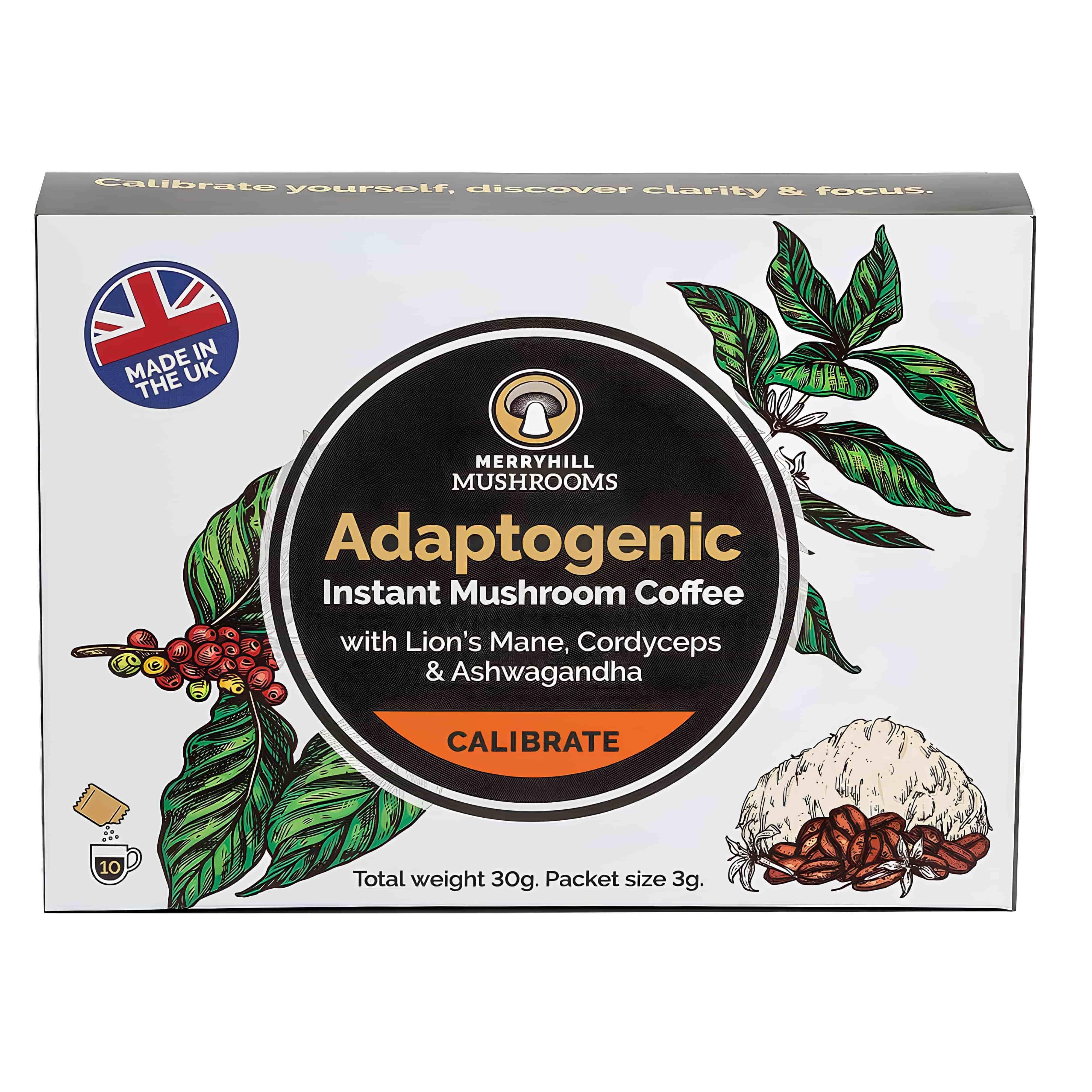
Adaptogenic Instant Mushroom Coffee, Calibrate (10 x 3g)
In the blend: Lion's Mane, Cordyceps and Ashwagandha, in a quick instant sachet.
Best for: an easy daily swap for your morning instant.
Price: £7.95 for 10 sachets (often on offer).
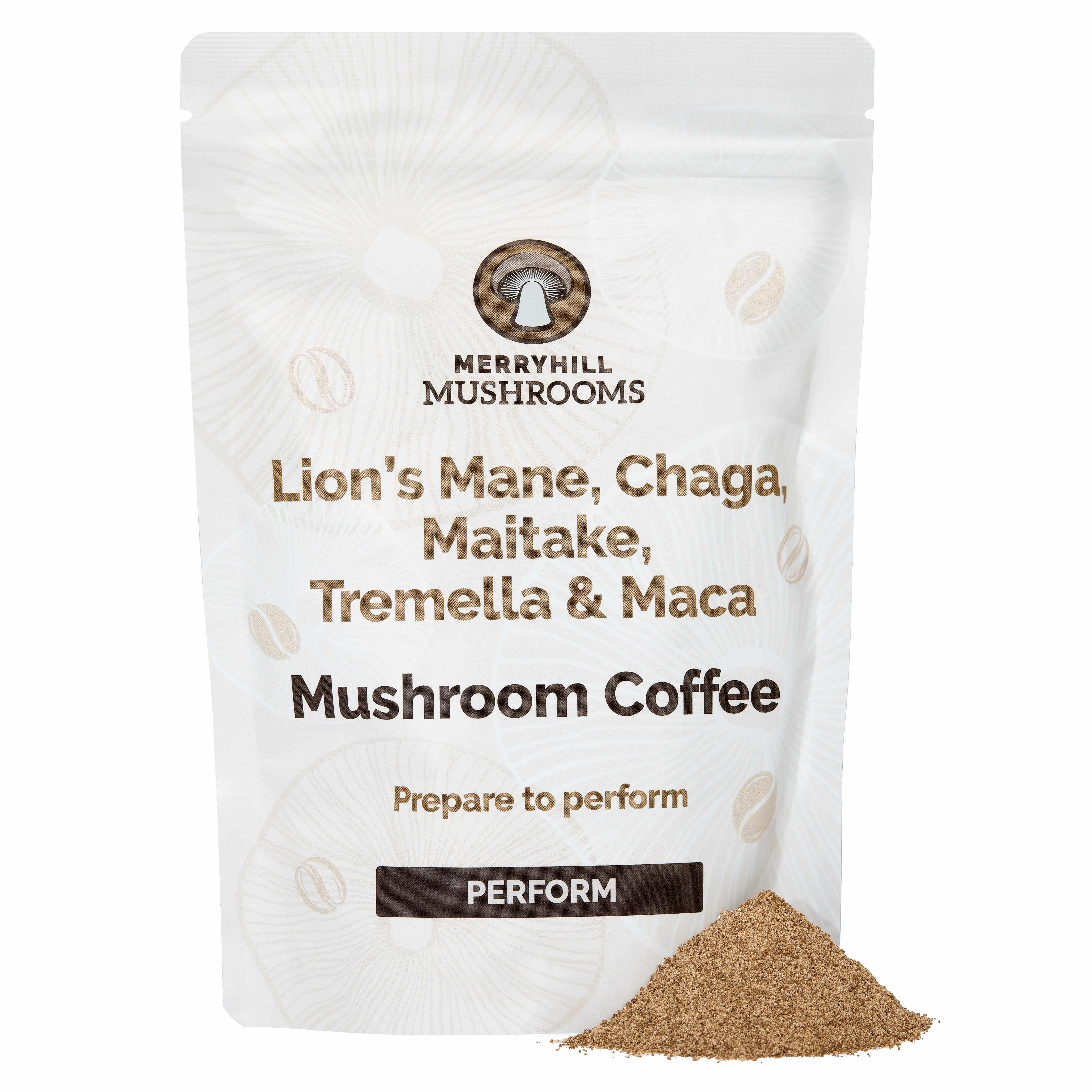
Lion's Mane, Chaga, Maitake, Tremella & Maca Coffee, Perform (180g)
In the blend: five functional mushrooms plus Maca, our fullest coffee blend.
Best for: anyone who wants the widest mix of adaptogens in one cup.
Price: £9.95 for 180g (often on offer).
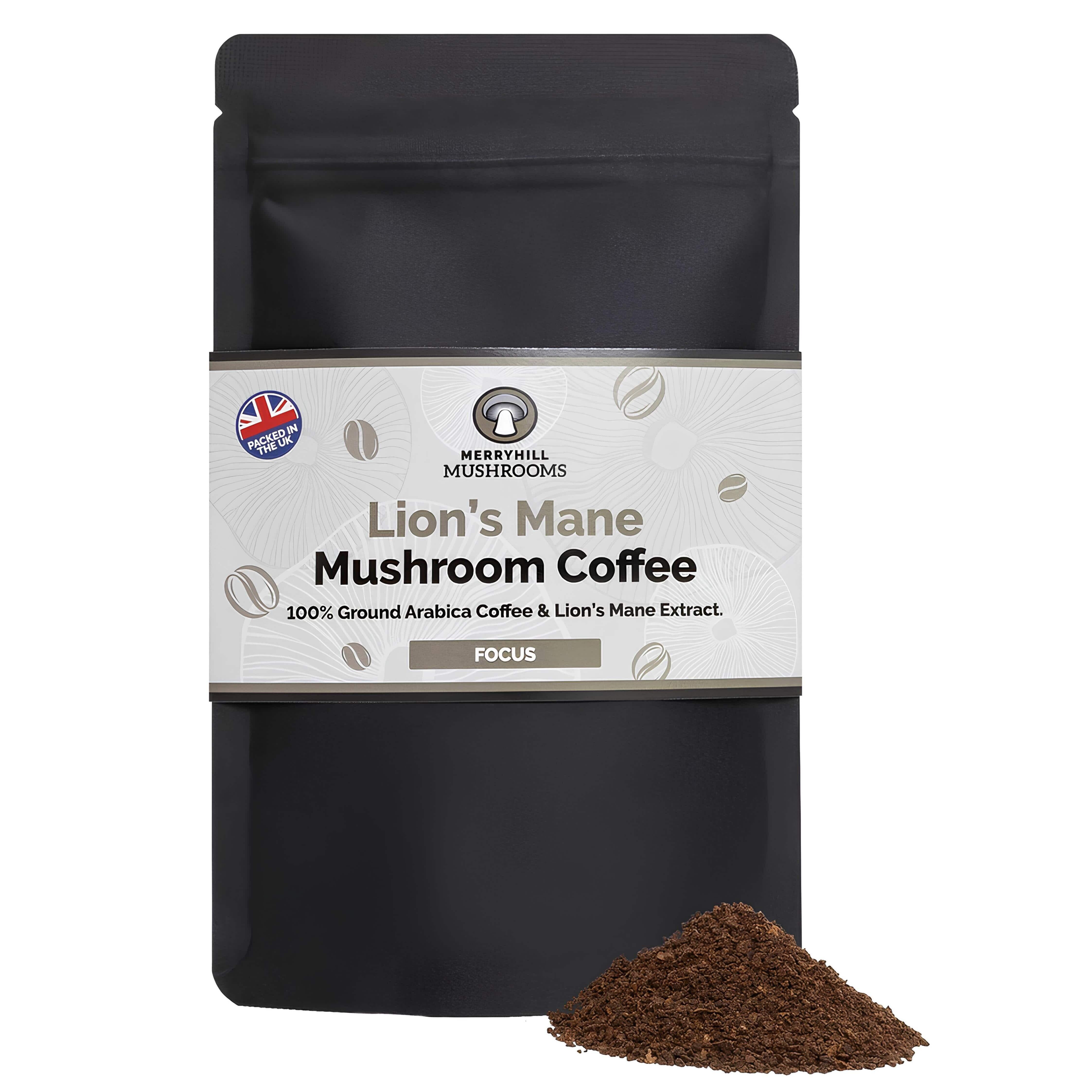
Lion's Mane Ground Coffee, Focus (80g)
In the blend: a medium-roast ground coffee made with Lion's Mane extract.
Best for: anyone who already brews and wants Lion's Mane in a proper cup.
Price: £5.95 for 80g, or £9.45 for the 250g bag.
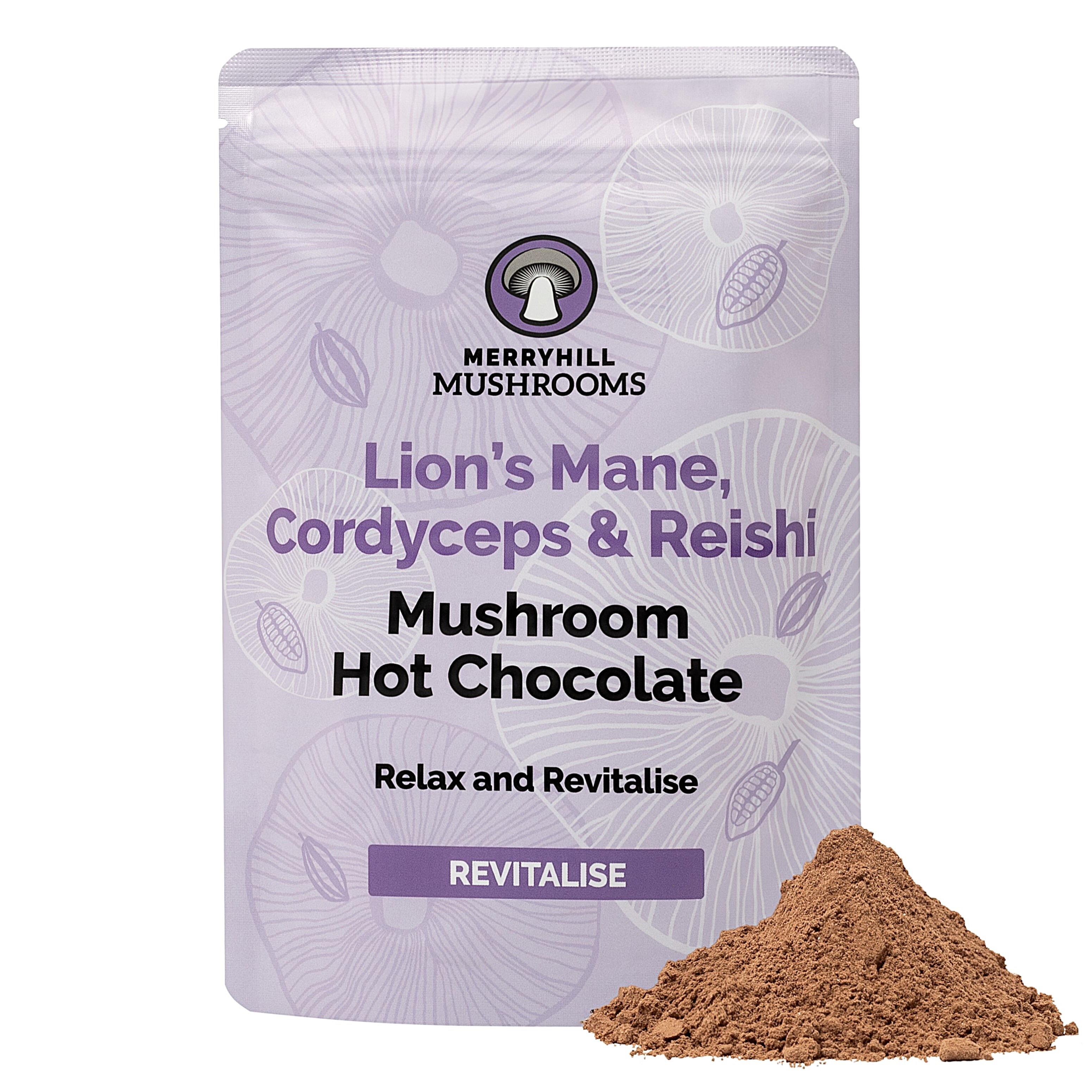
Lion's Mane, Cordyceps & Reishi Hot Chocolate, Revitalise (180g)
In the blend: Lion's Mane, Cordyceps and Reishi in a hot chocolate, caffeine-light and suited to the evening.
Best for: a calmer, sweeter alternative to a late coffee.
Price: £9.95 for 180g.
Is adaptogenic coffee safe? Who it suits, and who should take care
For most people, adaptogenic coffee is a normal coffee with a few extra food ingredients, so the main thing to watch is the caffeine, the same as any coffee. It suits people who want to keep coffee in their day while adding functional ingredients, without changing their routine or taking capsules. It is food and drink, not medicine.
If you are pregnant or breastfeeding, taking prescription medication, or sensitive to caffeine, it is worth checking with a doctor or pharmacist first, because some adaptogens can interact with medicines and most of these blends still contain caffeine. Start with one cup a day, and judge it over a couple of weeks rather than a single morning.
Fold adaptogens into the cup you already drink
Browse our full range of Merryhill Mushrooms adaptogenic coffee and hot chocolate. Instant, ground and evening blends, made in the UK with fruit body extracts only.
Shop the Coffee & Hot Chocolate RangeFrequently asked questions
What is adaptogenic coffee?
Adaptogenic coffee is coffee blended with adaptogens, meaning plants or mushrooms such as Lion's Mane, Cordyceps, Reishi, Ashwagandha or Maca that are traditionally used to help the body cope with stress. It brews and tastes like coffee, with a slightly earthier note.
Does adaptogenic coffee have caffeine?
Usually yes, because the base is real coffee. Most blends sit roughly in line with a normal cup unless the pack states a lower caffeine content, so check the label if you are cutting down. Hot chocolate blends tend to be lighter on caffeine.
Is adaptogenic coffee the same as mushroom coffee?
They overlap. Mushroom coffee uses functional mushrooms; adaptogenic coffee is the wider term that can also include plant adaptogens like Ashwagandha and Maca. A mushroom coffee is usually adaptogenic, but not every adaptogenic coffee contains mushrooms.
What does adaptogenic coffee do?
The adaptogens in it are traditionally used to support the body's response to stress, and the research on each is still developing. Any effect is individual and best judged over a couple of weeks. It is not a cure or a substitute for sleep, food and exercise.
When should you drink adaptogenic coffee?
Most people drink it first thing in place of their usual coffee. Morning blends built around Cordyceps and Lion's Mane suit the start of the day, while a Reishi hot chocolate suits the evening because it is lighter on caffeine. One cup a day is the usual starting point.
What does adaptogenic coffee taste like?
Like coffee, with a slightly earthier or malty background. A good blend does not taste of mushroom, and Lion's Mane ground coffee tastes closest to a normal medium roast. Milk or a hot chocolate format smooths out any earthiness.
Is adaptogenic coffee safe to drink every day?
For most people it is a normal daily coffee with added food ingredients, so the caffeine is the main thing to keep an eye on. If you are pregnant or breastfeeding, on medication, or caffeine-sensitive, check with a doctor or pharmacist first, since some adaptogens can interact with medicines.
How do you make adaptogenic coffee?
The same way as any coffee. Stir an instant sachet into hot water, or brew a ground blend in a cafetiere, filter or machine. Most people drink it in place of their usual morning cup and add milk to taste.
Published by Merryhill Mushrooms, growing gourmet mushrooms in Storrington, West Sussex for six generations.