Can Cats and Dogs Eat Mushrooms?
Mushrooms can be safe, risky, or dangerous for pets depending on the type of mushroom, where it came from, and how it was prepared. The clearest answer splits the subject into three categories: unknown wild mushrooms, known edible mushrooms sold for food, and human mushroom products such as cooked dishes, powders, and drinks.
The quick version:
- Wild mushrooms are the main risk and should always be treated as potentially poisonous.
- Shop-bought and home-grown culinary mushrooms are a separate category, but still need common sense.
- Dogs face the highest risk because they scavenge outdoors.
- Cats, rabbits, guinea pigs, hamsters, birds, and reptiles all need species-specific care.
- Plain edible mushrooms are less risky than cooked dishes with garlic, onion, butter, cream, or sauces.
- Mushroom coffees, hot chocolates, powders, and supplements are not suitable for pets.
- Mushroom growing kits are safer than wild mushrooms because the species is known and grown in controlled conditions.
- If a pet eats an unknown outdoor mushroom, contact a vet immediately. Do not wait for symptoms.
As a Sussex mushroom grower, we get this question often from customers ordering growing kits into homes with pets, and from people who have spotted something unfamiliar on the lawn after rain. The rest of this guide covers both sides: what counts as risky, what doesn't, and what to do if something goes wrong.
Why this topic gets confusing so quickly
Confusion starts because the word "mushroom" covers too many completely different things. Food mushrooms, wild mushrooms, mushroom drinks, grow kits, dried ingredients, and cooked leftovers all sit under the same broad label, even though the risk is not the same.
Searchers usually want one of three answers. Safety is the first. Urgency is the second. Prevention is the third. A useful guide needs to answer all three, because "can pets eat mushrooms?" is never really just one question.
Language also causes problems. "Human-safe" does not always mean pet-safe, and "edible" does not always mean suitable. The safest route is to separate mushrooms by source and use before making any judgement.
Are mushrooms safe for pets?
Mushrooms can be safe or unsafe depending on the type, source, and setting. Source matters more than the word "mushroom" on its own.
Veterinary guidance is very clear on the biggest divide. Grocery-store mushrooms and known food mushrooms are treated very differently from wild mushrooms found outdoors, because wild mushrooms can contain toxins that make dogs and cats very sick, or even lead to death. Unknown outdoor mushrooms should not be treated casually, even when they look harmless.
Pets also need separating by species. Dogs, cats, rabbits, guinea pigs, hamsters, birds, and reptiles do not share one simple feeding rule, so broad assumptions usually make the topic less safe rather than more helpful.
Why wild mushrooms are the real danger
Wild mushrooms are the main danger because identification is too risky for guessing. Outdoor fungi appear in gardens, parks, woodland, damp borders, and grassy areas after rain, and many pet owners cannot tell the difference between a harmless-looking mushroom and one that could cause serious poisoning.
Veterinary Partner says the mushrooms in the grocery store are safe to eat, but wild mushrooms along trails and even in backyards are a completely different story. The AKC also advises that if a dog has eaten a wild mushroom, the owner should contact a veterinarian, poison control centre, or emergency veterinary hospital immediately.
Garden risk matters for UK homes because the threat is not limited to long countryside walks. Lawn fungi can appear close to doors, paths, hutches, and pet play areas, so pet owners need to think about back gardens as well as parks.
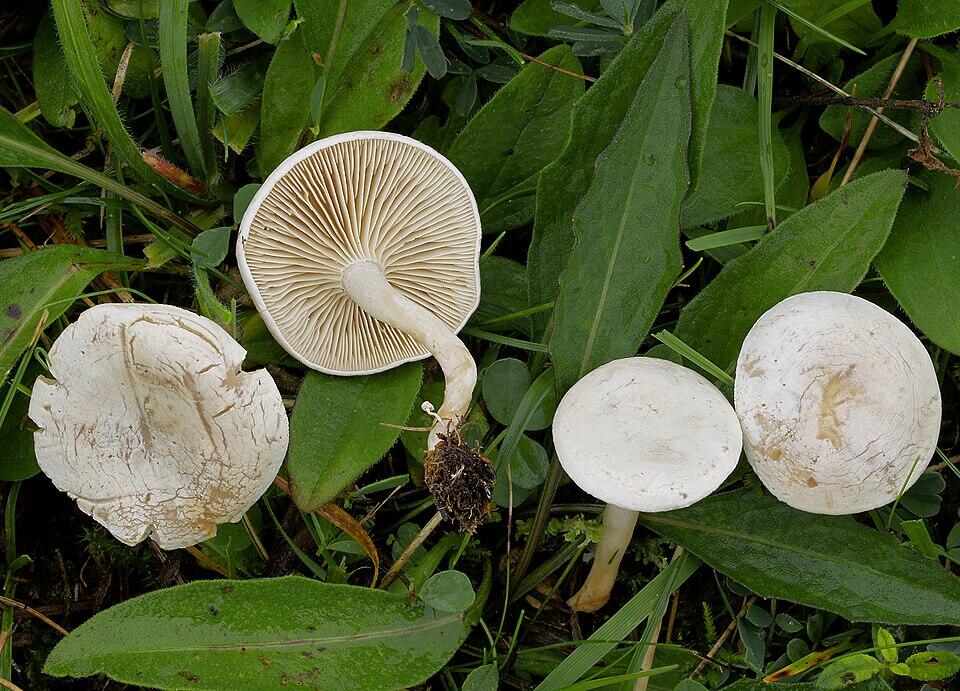
Lawn fungi can appear overnight after rain, even in tidy gardens.
Known edible mushrooms are a different category
Known edible mushrooms belong in a different category because the species are already identified and sold for food. Control is the key difference.
Shop mushrooms, culinary mushrooms, and known edible species grown in controlled conditions do not carry the same uncertainty as an unknown mushroom found outside. That does not mean pets should be deliberately fed mushrooms as a routine part of the diet, but it does mean the household question changes from "could this be toxic?" to "is this suitable at all, and how was it prepared?"
Preparation then becomes the next filter. Plain edible mushrooms are one thing. Rich leftovers with garlic, onion, butter, oil, or sauces are another. Many pet food worries come from the human dish around the mushroom rather than the mushroom itself.
Mushrooms considered safe for cats and dogs
- White button mushrooms (Agaricus bisporus)
- Chestnut mushrooms (Agaricus bisporus)
- Portobello mushrooms (Agaricus bisporus)
- Oyster mushrooms, including White, Pink, King, Yellow, and Black Pearl (Pleurotus ostreatus, Pleurotus djamor, Pleurotus eryngii, Pleurotus citrinopileatus)
- Shiitake (Lentinula edodes)
- Maitake (Grifola frondosa)
- Reishi (Ganoderma lucidum)
- Lion's Mane (Hericium erinaceus)
These are all commercially grown species. If you can buy it in a shop or grow it from one of our kits, it is safe for your pets in moderation, provided it is plain and unseasoned.
Wild mushrooms that are dangerous to cats and dogs in the UK
Wild mushrooms are where the real danger lies. The UK is home to several thousand mushroom species, and while the vast majority are harmless, a small number are extremely toxic to both pets and humans. The problem is that many dangerous species look very similar to safe ones, and even experienced foragers can make mistakes.
The safest approach is to treat every wild mushroom as potentially poisonous. If your cat or dog eats a wild mushroom, treat it as an emergency regardless of species. For a more detailed look at identifying UK wild mushrooms, including edible species and their dangerous lookalikes, see our UK mushroom identifier visual guide.
These are some of the most dangerous wild mushrooms UK pet owners should know about.
Death cap (Amanita phalloides)
Responsible for the majority of fatal mushroom poisonings worldwide. Found in broadleaf woodland, particularly near oak and beech trees, between August and November. Pale green, yellow, or white with a smooth cap and a ring around the stalk. Even a small piece can cause fatal liver and kidney failure in cats and dogs. Symptoms may not appear for 6 to 24 hours, by which point serious internal damage may already have occurred.
Destroying angel (Amanita virosa)
An all-white mushroom found in coniferous and broadleaf woodland. Less common than the death cap but equally lethal. Appears between August and November, often among pine and spruce. A single piece is enough to kill a cat or dog.
Fly agaric (Amanita muscaria)
The distinctive red-capped, white-spotted toadstool most people recognise from illustrations and fairy tales. Grows in woodland and heathland, particularly near birch trees, from July to November. Neurotoxic rather than liver-toxic, causing tremors, seizures, stumbling, abnormal behaviour, and in rare cases, death from secondary trauma during seizures.
Fool's funnel (Clitocybe rivulosa)
One of the most common poisonous mushrooms in the UK and one of the easiest to encounter, because it frequently grows on lawns, in parks, and by roadsides. Small, white, and only around 6cm tall, making it easy to miss. Contains muscarine, which affects the nervous system and can cause salivation, diarrhoea, breathing difficulties, and a dangerously slow heart rate.
False morel (Gyromitra esculenta)
Looks somewhat like an edible morel but has a wrinkled, brain-like cap rather than a honeycomb texture. Contains hydrazine toxins that can cause severe vomiting, diarrhoea, and in serious cases, liver damage. Found in coniferous woodland, typically in spring.
Mushrooms in your garden count as wild mushrooms. Mushrooms that spring up on your lawn, in flower beds, or around tree stumps are wild mushrooms, even though they are growing on your property. They can appear overnight, especially after rain in mild weather. If you have pets, check your garden regularly and remove any mushrooms you find before your cat or dog gets to them.
Dogs and mushrooms
Dogs are the biggest mushroom scavenging risk in most homes. Curiosity, speed, and poor judgement make dogs more likely to grab something from the garden and swallow it before anyone can stop them.
Veterinary Partner notes that mushroom poisonings are most often reported in dogs. AKC's dog guidance follows the same logic and treats wild mushroom ingestion as urgent, because dogs are far more likely to "chow down" on a toxic mushroom outdoors.
Plain edible mushrooms are still a separate question from wild mushrooms. A tiny accidental nibble of a known culinary mushroom is not the same scenario as a dog eating an unknown fungus from the grass.
Can dogs eat edible mushrooms at all?
Dogs can sometimes eat tiny amounts of plain edible mushrooms, but that does not make mushrooms an especially useful dog food. Simplicity is the safest frame here.
Plain cooked edible mushrooms are easier to think about than raw or seasoned ones. Added ingredients are often the bigger issue, because garlic, onion, cream, butter, and heavily salted leftovers change the risk quickly, even when the mushroom itself is an edible species. AKC's public advice draws exactly that distinction by treating store-bought mushrooms differently from wild mushrooms while still warning owners about the wider context.
Moderation still matters. Dogs do not need mushrooms as a daily diet addition, and there is little gain in turning a simple safety question into a feeding experiment.
Cats and mushrooms
Cats need caution for a different reason. Diet differences make cats less suitable for casual human-food sharing in general, and poisoning advice for cats stresses immediate action when a harmful substance may have been eaten.
Cats Protection advises owners to seek veterinary advice immediately if they think a cat has eaten a poisonous substance, even if the cat appears well. Cats Protection also advises against feeding cats human food generally, because many human foods are not appropriate and some can be harmful.
Known edible mushrooms are still different from wild mushrooms, but that does not mean mushrooms need to become a cat treat. Cats are obligate carnivores, and the safest practical answer is usually to avoid deliberate mushroom feeding altogether.
Rabbits and guinea pigs need a stricter rule
Rabbits and guinea pigs need a stricter rule because their diets are highly specialised. Fibre, hay, and species-appropriate greens are the centre of their feeding world, not human food experiments.
RSPCA says a rabbit's digestive system needs hay or grass to function properly and recommends a diet built mainly around hay and fresh grass, with a smaller share of leafy greens and pellets. That kind of guidance does not create a strong case for adding mushrooms into the diet casually, especially when rabbits are sensitive to sudden dietary changes.
Guinea pigs follow the same broader principle. Stable, species-specific feeding matters more than curiosity, and mushrooms simply do not sit at the centre of that kind of diet planning. For these pets, avoiding mushroom experiments is usually the clearest and safest advice.
Hamsters, gerbils, rats, and mice should not be used for mushroom guesswork
Hamsters and other small rodents leave very little room for mistakes. Body size alone makes careless feeding more risky.
RSPCA's hamster diet guidance emphasises appropriate, balanced feeding rather than improvising with random human foods. That same logic should guide mushroom questions too.
Wild mushrooms are clearly the wrong category. Rich mushroom leftovers are also a poor idea. Even edible human mushrooms do not need to become part of a rodent feeding routine just because they are safe for people.
Small pets are also harder to assess when something goes wrong. A tiny nibble can still matter. That is why caution should stay much stricter than it is for an accidental dog-food question.
Birds and parrots need species-specific caution too
Birds need species-specific guidance because one broad "pet-safe" rule does not work across parrots, budgies, canaries, and other companion birds. Diet planning for birds is already structured, and casual human-food sharing often creates more confusion than value.
RSPCA's bird diet guidance focuses on pellets, seeds depending on species, fruit, and vegetables in balanced amounts. Mushrooms do not sit at the centre of that public guidance, which means pet owners should not improvise with them casually.
Outdoor risk still matters for birds as part of the wider home environment. Wild fungi in aviaries, runs, or shared outdoor areas should be removed just as they should for dogs and cats, because prevention is always easier than reacting later.
Reptiles and tortoises are not an exception
Reptiles and tortoises also need species-specific feeding rather than mammal-style assumptions. Herbivorous tortoises, insect-eating reptiles, and omnivorous reptiles do not share one sensible "safe mushroom" answer.
Species differences make general feeding advice difficult, which means the safest broad public rule is simple: do not assume mushrooms belong in a reptile diet unless species-specific veterinary advice says otherwise. Household hazard advice from AVMA supports the wider prevention principle by reminding owners that many ordinary home items can become risks when they are not meant for that animal.
That may sound cautious, but caution is the right tone here. A good guide should reduce bad assumptions, not create new ones.
Raw, cooked, and seasoned mushrooms are not the same thing
Preparation changes the question even when the mushroom itself is edible. Plainness is the easiest rule to remember.
Raw edible mushrooms are not the same emergency as a wild outdoor mushroom, but they still are not the clearest or most useful thing to feed a pet. Plain cooked mushrooms are easier to understand because texture changes, and strong added ingredients are absent. Rich leftovers, creamy toppings, garlic butter, and onion-heavy sauces create a different risk entirely and should not be confused with the underlying mushroom species.
The same logic applies to kitchen accidents. A pet stealing a forkful of mushroom stroganoff is not just "eating mushrooms." It is eating a cooked human dish with multiple ingredients that may not suit that animal at all.
What about mushroom coffee, hot chocolate, powders, and supplements?
Mushroom coffees, hot chocolates, powders, and supplements belong in a human-product category, not a pet-food category. The mushroom content is not usually the problem. It is everything else mixed in with it.
For dogs especially, the cocoa in hot chocolate contains theobromine, which is well-established as toxic to dogs and cats. The caffeine in mushroom coffee is also a known risk for both species, and the concentration in a powdered blend can be higher than you might expect. Sweeteners, particularly xylitol, are another serious danger if a product uses them. These ingredients, not the mushrooms, are what make these products unsuitable for pets.
Household storage matters more than feeding in this case. Powders, drinks, and supplements should be kept sealed, high up, and out of reach, just like any other specialist food or supplement product in the home. PDSA's general poison-and-hazard guidance supports the wider principle that ordinary household items can become dangerous very quickly when pets get into them unsupervised.
Are mushroom growing kits safer than wild mushrooms?
Mushroom growing kits are easier to judge because the species are known and the growing environment is controlled. Control is the key difference again.
All the species we grow at Merryhill, whether that is Chestnut, White, Shiitake,Lion's Mane, or any of our oyster varieties (White, Pink, King, Black Pearl), are the same species you would find in a supermarket. None of them are toxic to cats or dogs. A known culinary species in a home-growing kit is nothing like an unknown outdoor fungus after rain.
That does not mean pets should be allowed to chew the substrate, paw at the bag, or nibble growing mushrooms, but it does mean the household question shifts from toxic identification to sensible placement and supervision.
Home placement usually solves most of the problem. A shelf, utility-room surface, or worktop out of reach is a much better choice than a low surface in an active pet area.
What should you do if your pet eats a mushroom?
Speed is the right first response if the mushroom was outdoors and unknown. Delay is the wrong move.
RSPCA says to contact your vet immediately if you think your dog has been poisoned. Cats Protection says the same kind of urgent veterinary contact is needed for cats, even if the cat appears fine at first. PDSA also stresses that acting fast can make all the difference if you think your pet has eaten something poisonous.
Useful details can help, but they come second. A photo of the mushroom, the location where it was found, and any remaining pieces may help the vet, but none of that should slow down making contact.
UK emergency contact
If you cannot reach your vet immediately, the Animal PoisonLine is available on 01202 509 000. This is a paid service run by the Veterinary Poisons Information Service.
What signs should you watch for?
Symptoms vary because different toxins act differently. Variation is one reason mushroom poisoning needs a vet rather than home guesswork.
Veterinary Partner says symptoms can range from vomiting and diarrhoea to seizures and death depending on the toxin involved. PDSA says poisoning signs may take hours or even days to appear, which means "they look fine now" is not a good reason to wait.
Vomiting, diarrhoea, drooling, weakness, wobbliness, tremors, unusual sleepiness, and seizures are all signs that need to be taken seriously if a mushroom may have been eaten. Unknown mushroom plus any worrying sign should always lower the threshold for calling the vet.
How to reduce risk at home and in the garden
Prevention starts with garden checks. Rainy periods, damp corners, and compost-rich spots are the main places to look if your dog or outdoor cat uses the garden.
Kitchen prevention matters too. Store dried mushrooms, powders, drinks, and cooked mushroom leftovers out of reach. Keep grow kits away from pet feeding areas, pet bedding, and low surfaces where they can be pawed, chewed, or knocked over.
Routine helps more than complexity. One quick look around the lawn after rain and one sensible storage system in the kitchen will prevent far more problems than any amount of panic-reading after an incident.
Frequently asked questions
Can cats eat raw mushrooms?
Raw shop-bought or home-grown mushrooms are not toxic to cats, but cooked mushrooms are easier for them to digest and less likely to cause mild stomach upset. If you cook mushrooms for your cat, serve them plain with no butter, oil, garlic, or seasoning. Most cats have little interest in mushrooms either way.
Can dogs eat raw mushrooms?
A small amount of raw, plain, shop-bought or home-grown mushroom is not toxic to dogs, but dogs do not need mushrooms as part of their diet. If you do offer some, cut it into small pieces to avoid choking, and never give mushrooms that have been cooked with garlic, onion, butter, or seasoning.
Are mushroom growing kits safe to have around pets?
Yes. Our kits grow the same species sold in supermarkets, all of which are non-toxic to cats and dogs. The main concern is keeping the kit out of reach so your pet does not damage it. If your cat or dog does nibble a mushroom from the kit, there is no danger.
My dog ate a mushroom in the garden. What should I do?
Treat it as an emergency. Contact your vet or call the Animal PoisonLine on 01202 509 000 immediately. If you can, collect a sample of the mushroom (using gloves or a damp paper towel) and place it in a paper bag to bring to the vet. Do not wait for symptoms to appear, as some of the most dangerous species show delayed effects.
Can mushrooms from a growing kit harm my cat if she nibbles the substrate?
The substrate (growing block) in our kits is not toxic. It is made from organic material designed to support mushroom growth. If your cat nibbles at it, the main risk is to the kit's performance, not to your cat. That said, it is best to keep kits out of reach so they are not disturbed.
What are the most dangerous mushrooms for pets in the UK?
The death cap (Amanita phalloides) is the single most dangerous species, responsible for the majority of fatal mushroom poisonings. The destroying angel, fly agaric, and fool's funnel are also significant risks. Fool's funnel is particularly concerning for pet owners because it commonly grows on lawns and in parks. For help recognising these and other UK species, see our mushroom identifier guide.
Can dogs tell the difference between safe and toxic mushrooms?
No. This is a common myth. Dogs cannot identify toxic mushrooms by smell, and some of the most dangerous species (like the death cap) actually have a slightly fishy odour that dogs find attractive. Never rely on your dog's instincts to keep them safe from wild mushrooms.
Are dried mushrooms safe for cats and dogs?
Dried culinary mushrooms such as our porcini are not toxic to cats or dogs, but they are not a pet food either. The flavour is very concentrated, the texture is drier than fresh, and in cooking they are usually rehydrated into a seasoned dish that will not suit pets. If you want to offer your pet a mushroom as an occasional treat, stick to a small amount of fresh, plain, cooked mushroom instead.
How quickly do mushroom poisoning symptoms appear?
It depends on the species. Some toxic mushrooms cause vomiting and diarrhoea within 15 to 30 minutes. Others, including the death cap, may not produce noticeable symptoms for 6 to 24 hours. As a general rule, the later the symptoms appear, the more serious the poisoning is likely to be. This is why you should contact a vet immediately after any wild mushroom ingestion, not wait to see if symptoms develop.
Are all mushrooms dangerous to pets?
No. Known edible mushrooms are different from unknown wild mushrooms. Wild mushrooms are the main danger and should be treated as the urgent category.
Can dogs eat supermarket mushrooms?
A tiny amount of a plain edible mushroom is not the same as a wild mushroom emergency, but dogs do not need mushrooms as a regular food, and seasoned leftovers are a different risk again.
Are mushrooms safe for rabbits and guinea pigs?
Rabbits and guinea pigs do best on species-appropriate diets centred on hay, fibre, and suitable greens. Mushrooms are not something to experiment with casually in those pets.
What should I do if my pet eats a wild mushroom?
Contact your vet or an emergency veterinary service straight away. Do not wait for symptoms before asking for help.
Mushrooms and pets become much easier to understand once one rule stays front and centre. Unknown wild mushrooms are the real danger. Known edible mushrooms are a different category that still needs common sense.
Grow mushrooms you know are safe
Our ready-growing kits use the same species you find in the supermarket, grown in controlled conditions on our Sussex farm. Six generations of mushroom growing experience in every box.
Shop growing kitsPublished by Merryhill Mushrooms. Six generations of mushroom growing in Storrington, West Sussex.