
Can You Grow White Oyster Mushrooms Outdoors in the UK?
Can You Grow White Oyster Mushrooms Outdoors in the UK?
Yes, on a hardwood log. The honest UK guide to outdoor oyster growing, how it compares with an indoor kit, and which oyster to choose.
Yes. White Oyster mushrooms grow well outdoors in the UK on a freshly cut hardwood log inoculated with spawn plugs. The honest caveat is time. A log takes 12 to 18 months to colonise before it fruits, then crops for three to five years. If you want mushrooms this month, an indoor ready growing kit is the faster route.
Key takeaways
White Oyster is Pleurotus ostreatus var. florida, a cultivated selection of the wild oyster that already grows on hardwood across Britain.
An outdoor log kit contains 30 spawn plugs, beeswax and full instructions. You supply the log, a drill with an 8mm bit and a way to melt the wax.
Colonisation takes 12 to 18 months. The log then fruits for three to five years, usually in spring and autumn.
Suitable hardwoods are oak, beech, birch, alder, ash and elm. Fruit woods work. Softwoods and conifers do not.
Log kits start from £10.00, dropping to £8.00 each when you order more than two of the same variety. Plugs keep in the fridge for two to three months.
Indoor ready growing oyster kits crop in 7 to 10 days and give two to three harvests over three to four weeks.
Most people asking this want both things: a log in the garden for the long term, and mushrooms on the plate soon. That is how we would do it ourselves. Start a log from the outdoor mushroom log growing kits range, where White Oyster, Summer Oyster and Tarragon Oyster are all variety options, and run a White Oyster ready growing kit indoors the same week. One feeds you in ten days. The other feeds you for years.

The Ready Growing indoor kit arrives pre-colonised and fruits in around 7 to 10 days
What does Pleurotus ostreatus var. florida mean for outdoor growing?
White Oyster is a pale variety of the common oyster mushroom. The parent species, Pleurotus ostreatus, is native to Britain and fruits naturally on dead and dying hardwood, which is the biggest single reason outdoor cultivation works here at all. You are not forcing a tropical fungus through a Sussex winter. You are giving a wood-rotting fungus the wood it already wants.
The "var. florida" part signals a cultivated strain, selected for a warmer fruiting preference than the darker wild-type oysters. In practice a White Oyster log is slower in cold snaps and more willing in mild, damp spells. That same warmth preference makes White Oyster forgiving indoors, which is why we point beginners toward it. More detail sits in our guide to White Oyster mushrooms and what var. florida means.
Does the UK climate suit outdoor oyster mushrooms?
Broadly yes, with two awkward periods.
Spring and autumn are the good windows. Mild air, regular rain, high humidity in a shaded corner. That is what oysters fruit into, and it is why most UK log growers see flushes in April and May, then again from September into November.
Summer is the first awkward period. Dry, hot weeks stall a log. The wood dries, the mycelium sits tight, and nothing happens until the rain returns. That is a pause, not damage. Deep shade and a soak with a hose keeps the log in condition.
Winter is the second. Frost does not kill the fungus inside the log. Cold simply slows everything and fruiting largely stops until temperatures lift. A log standing through a Sussex winter is doing nothing visible and is perfectly fine.
Which logs suit oysters, and how is that different from Shiitake?
Use freshly cut hardwood. Oak, beech, birch, alder, ash and elm all work. Fruit woods such as apple, plum and cherry are acceptable. Softwoods and conifers are not: their resins work against the fungus.
The difference between oysters and Shiitake is appetite. Shiitake is fussier and does best on denser, tannin-rich woods, oak in particular. Oysters are the opportunists, happier on softer hardwoods, so a birch or alder log a Shiitake grower rates second choice is often a good oyster log. Faced with a mixed pile, put the oak aside for Shiitake and give the birch and beech to your oysters.
Freshness matters more than species. The log wants to be cut recently and still heavy with sap, ideally plugged two to eight weeks after felling. Drilled sooner than two weeks, the fresh wood's anti-fungal compounds can hold the spawn back; left longer than eight weeks, something else has usually claimed it, like an old log sitting in a hedge for a year.
How does the plug spawn method work?
The short version. Drill a grid of 8mm holes across the log, tap a spawn plug into each until it sits flush, then seal every plug and both cut ends with melted beeswax. Stand or lay the log in deep shade, off bare soil, and leave it alone.
Each Merryhill Mushrooms log kit carries 30 plugs, the beeswax and full instructions. You bring the drill, the 8mm bit and something to melt wax in. Plugs go in the fridge on arrival and keep for two to three months. Our step by step walkthrough, including hole spacing and what the wax is doing, is in how to grow mushrooms on outdoor logs. Read it before you drill.
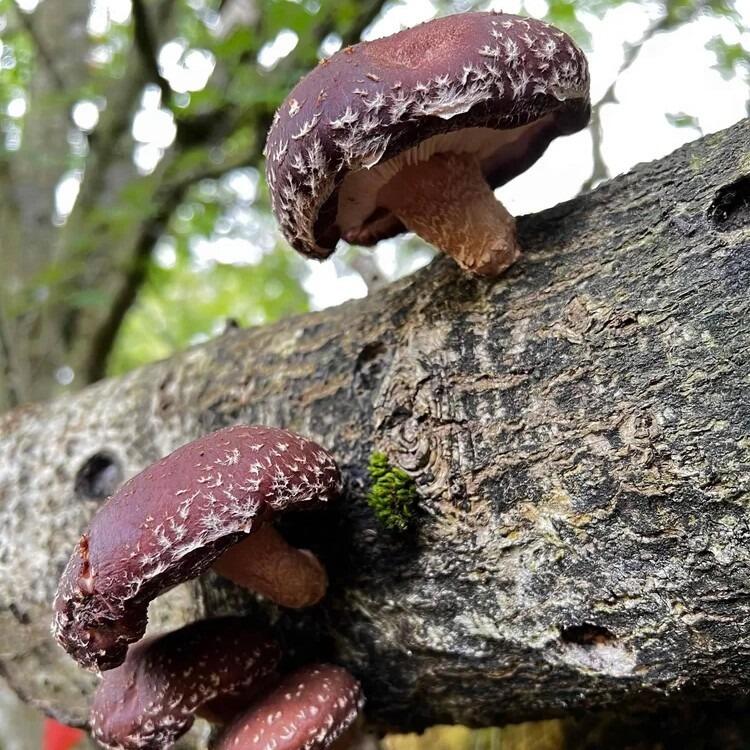
Outdoor log kits include 30 inoculated dowels and beeswax for sealing
Stumps and totems
Two variations are worth knowing. A fresh hardwood stump can be plugged the same way, and because it holds moisture from below it often fruits more reliably than a cut log in a dry garden. The drawback is that you cannot move it.
A totem is a stack: a short log section, a layer of spawn, another section on top, wrapped to hold moisture. It suits sawdust spawn better than plugs and colonises faster, but it is messier and shorter lived. For most gardeners, plugs in a log remain the sensible first go.
How do outdoor oysters differ from indoor kit oysters?
They eat differently, so they taste different.
An indoor kit fruits from a prepared substrate and produces fast, tender, pale clusters with plenty of moisture in them. Lovely in a pan, quick to cook, gone in a minute.
A log oyster grows slowly out of solid wood. Caps come thicker and firmer, often larger across, with a denser bite and a deeper, more savoury flavour. They hold their shape in a hot pan, so they suit roasting and grilling rather than a fast fry. Colour varies more outdoors too, since light and weather both influence the cap.
Neither is better. They are two ingredients from one species, and our notes on how to cook oyster mushrooms apply to both.
When should you inoculate, and when do the flushes come?
Inoculate when you have a fresh log, which usually means late winter through spring after the tree work is done. Autumn works too. Avoid drilling in a heatwave, when a cut log dries out in hours.
Then expect nothing for a long while. Colonisation takes 12 to 18 months, and the only sign is often a faint white edge of mycelium on the cut grain. After that the log fruits, and keeps fruiting for three to five years, tailing off as the wood is used up.
Flushes follow weather rather than a calendar. A warm, wet spell after cool days is the classic trigger. Once a log is productive you usually get a spring push and an autumn push, with the occasional surprise in a damp August.
Worked example one: a beech log plugged in spring
A gardener in Sussex has a beech log from a tree taken down in February, roughly a metre long and as thick as a thigh. In March she orders a White Oyster log kit and keeps the plugs in the fridge for a fortnight until a dry weekend arrives, well inside the two to eight week window after felling.
She drills 30 holes in a diamond pattern, taps in every plug, and seals each one plus both ends with beeswax. The log goes behind the shed on two bricks, in shade, out of the wind. She waters it in a dry spell in June and again in August, then forgets about it.
Year one: nothing. That is correct and expected. By the following spring the cut ends show white where the mycelium has run through. Still nothing to pick.
Year two: that September, after three days of rain, small clusters push out of the plug holes on the shaded side. She picks a colander's worth over a week, and a second, smaller flush arrives the following April. From there the log is in production and should flush twice a year for several seasons. Total effort after inoculation day: two waterings a year and a look after every wet spell.
Worked example two: mushrooms this month and a log for later
A reader in August wants oyster mushrooms to cook, not a project. He orders a White Oyster ready growing kit and, in the same order, a White Oyster log kit.
Day one, the kit arrives, he cuts the holes and starts misting twice daily. Day three, pins appear. Day eight, first harvest. Over three to four weeks he gets two to three harvests, following the White Oyster growing instructions.
Meanwhile the plugs sit in the fridge. In October, when a neighbour's ash comes down, he takes a section, drills it, plugs it and stacks it behind the compost bins. He has eaten mushrooms within a fortnight of ordering and has a log that should feed him from late 2027 onward. Outdoors works. Indoors is faster. Doing both costs less than most people assume.
Are native oysters a better outdoor choice?
For a UK garden there is a good case for them. Summer Oyster and Tarragon Oyster are native varieties, adapted to the conditions your log will sit in: British temperatures, British rainfall, British seasons. Both are options on the log kit range alongside White Oyster.
Summer Oyster earns its name by fruiting readily in warmer months, filling the gap when other strains stall. Tarragon Oyster carries a distinct aniseed note. Try either indoors first: the Summer Oyster ready growing kit and the Tarragon Oyster ready growing kit use the same misting routine as White Oyster.
Can you use spent kit substrate outdoors?
You can put it outside. What you should not do is expect a second crop from it.
Spent substrate has already given up most of what the fungus wanted. Tipped into a shady bed, mulched over damp cardboard or spread under shrubs, it sometimes throws a small opportunist flush after heavy rain, and more often it simply breaks down into good soil. Both outcomes are useful. Neither is a growing method.
Treat it as compost with a chance of a bonus. For a crop you can count on, that is what the log is for. More in why you should reuse spent mushroom substrate.
How do you stay safe about what you are picking?
Two rules keep this simple.
First, only eat what comes out of your own inoculated log, from your own plug holes, in the pattern you drilled. Anything fruiting elsewhere in the garden, or on a log you did not inoculate, is not your crop and not for the pan.
Second, a cultivated log is not foraging. Wild oyster identification takes real experience and there are lookalikes that catch people out. Growing your own removes that risk because you know what went into the wood. If you are unsure about anything on or near your log, do not eat it.
Troubleshooting outdoor oyster logs
Nothing showing after a year. Almost always normal. Colonisation runs 12 to 18 months. Check the cut ends for white mycelium, keep the log shaded and damp, and wait.
Slugs. They find log mushrooms before you do. Pick young and raise the log off the soil on bricks so there is less of a ramp.
Log drying out. The commonest real failure. A log in sun or wind loses moisture faster than the fungus can cope with. Move it into deep shade and soak it in dry spells.
Competitor fungi. Brackets, moulds or unfamiliar growths on the bark mean something else got a foothold, usually because the log was not fresh. A vigorous oyster colony often outcompetes them. A log losing the fight is best composted.
Long, thin stems with small caps. Poor air movement, usually on a log tucked into a tight corner. The same cause applies indoors, and the fix is in why oyster mushroom stems go long and thin.
Outdoor log oysters or indoor ready growing kits?
Set them side by side and the choice makes itself.
On speed there is no contest: an indoor kit gives mushrooms in 7 to 10 days, a log in 12 to 18 months. On longevity it reverses. The kit gives two to three harvests across three to four weeks and is finished. The log crops for three to five years.
On effort, the kit asks for twice-daily misting for a month; the log asks for one afternoon of drilling and waxing, then almost nothing. On cost per mushroom the log wins comfortably, especially at £8.00 per kit when you order more than two of the same variety.
On control the kit wins, because you set temperature, humidity and timing while outdoors the weather decides. On flavour they differ rather than compete. And on reliability the kit is the safer bet for a gift or anyone who wants a result, whilst the log suits a gardener who enjoys the wait.
Grow White Oyster mushrooms your way
Fast results indoors, or a long-term outdoor log project that crops for years. Both start here.
Shop growing kitsFrequently asked questions
Can White Oyster mushrooms survive a UK winter outdoors?
Yes. The mycelium inside the log is not harmed by frost. Cold slows it and fruiting largely stops, but the colony sits dormant in the wood and picks up when temperatures rise. You do not need to wrap, move or protect the log. The main winter risk is not cold at all, it is a log that dried out during the previous summer.
How long does a White Oyster log keep producing?
Three to five years from the point it starts fruiting. Yields peak in the middle years and decline as the fungus works through the wood. Toward the end the log becomes soft and crumbly and can be broken up into the garden. Many growers plug a fresh log every couple of years so there is always one coming into production as another retires.
Do I need a specific size of log?
No fixed rule, but 30 plugs suit a log around a metre long and roughly the thickness of your thigh. Thinner logs colonise faster and are exhausted sooner. Thicker logs take longer to colonise and crop for longer. Full spacing guidance comes with every outdoor mushroom log growing kit.
Can I grow oyster mushrooms outdoors without a log?
Not dependably. Outdoor beds and straw piles are possible but exposed to weather, pests and competing fungi, and results vary wildly between gardens. Logs are the method we sell and recommend because they consistently work in a British garden with no special equipment. A kit in a sheltered porch or unheated greenhouse is the more predictable alternative.
I currently grow a Yellow Oyster kit. What should I grow next?
Everything you have learned transfers directly, because the misting routine, harvest timing and airflow needs are the same across oyster varieties. For your next kit, White Oyster is the closest match in habit, Pink Oyster gives similar colour and drama, and Summer Oyster or Tarragon Oyster bring native varieties that also work on outdoor logs.
Is a log kit a sensible gift?
Yes, and a popular one. Plugs keep in the fridge for two to three months, so the recipient can wait for the right weekend and the right log. A handwritten gift note can be added for £0.50. If you want the recipient to see something happen straight away, pair the log kit with a ready growing kit from the mushroom growing kits range.
Will an outdoor log fruit at the same time as an indoor kit?
No, and that is the point of running both. The indoor kit fruits on your schedule within days of opening. The log fruits on the weather's schedule, usually spring and autumn, once it has finished colonising. Between the two you can have oysters at short notice all year and a free crop from the garden twice a season. Our general guide to how to grow oyster mushrooms covers both routines.
What if my log never fruits at all?
The cause is nearly always the wood rather than the spawn: a log that was too old, too dry, from a softwood, or left in sun. Give it a full two years before writing it off. If the cut ends never show white mycelium after that time, break it up for the compost heap and start again with a freshly cut hardwood log in deep shade.
Start where it suits you. For mushrooms on the plate within a fortnight, take a White Oyster ready growing kit and follow the misting routine. If you have a fresh hardwood log and a shady corner, take a log kit from the outdoor mushroom log growing kits range, from £10.00, and give yourself years of autumn harvests. Six generations of growing here says the same thing: do both, and you will never be short of oysters.
Related reading
Published by Merryhill Mushrooms
Sussex, UK | Six generations of mushroom growing excellence