
King Oyster vs Black Pearl Oyster: Which Kit Should You Choose?
King Oyster vs Black Pearl Oyster: Which Kit Should You Choose?
Two meaty, gourmet varieties from the same family, but very different to grow and cook
Both kits produce thick, satisfying mushrooms that hold their own in the pan. Both use a log format with topsoil. Both are more substantial than standard oyster varieties. But beyond those similarities, King Oyster and Black Pearl Oyster are quite different mushrooms, and the right choice depends on what you want to grow and eat.
Quick answer
King Oyster (Pleurotus eryngii) has a distinctive trumpet shape with a thick stem, mild flavour, and a longer growing timeline of 14 to 21 days. Black Pearl (Pleurotus ostreatus x eryngii) is a hybrid of King Oyster and standard oyster, producing clusters of dark-capped mushrooms faster, in 15 to 20 days, with a fuller flavour. Both use the same log and topsoil setup. If you want the classic thick stem, choose King Oyster. If you want the look and ease of an oyster with more depth than standard varieties, choose Black Pearl.
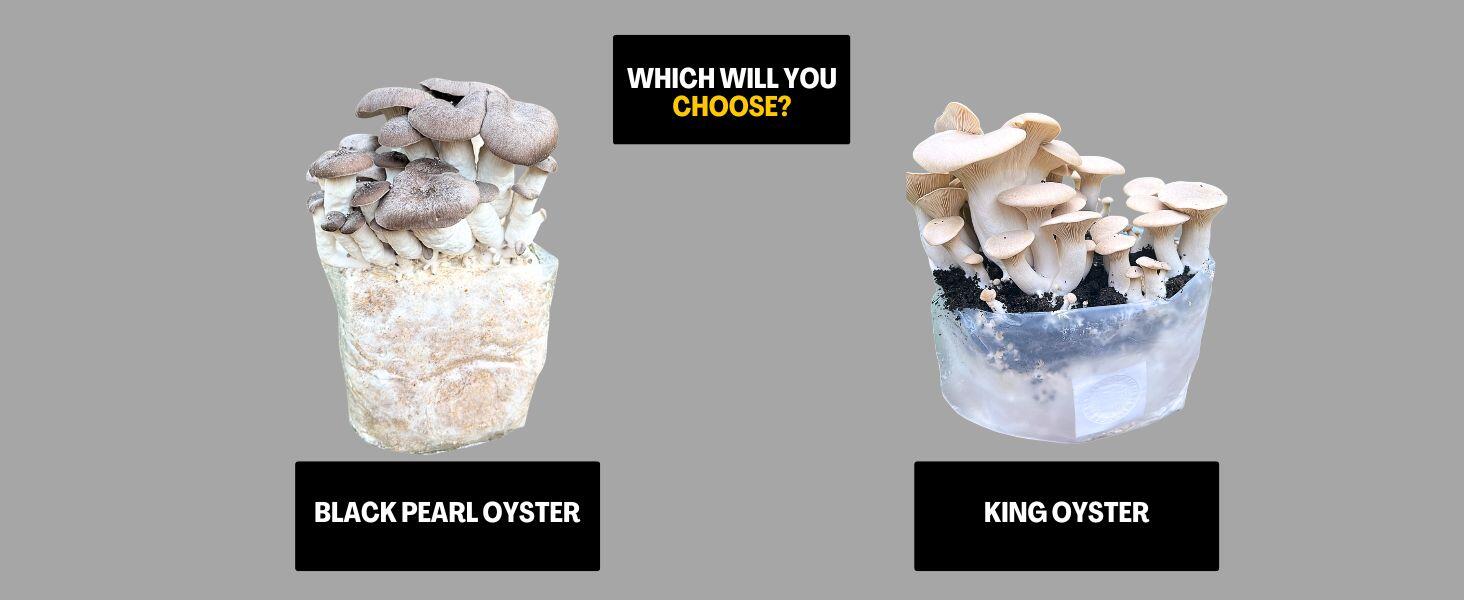
Both King Oyster and Black Pearl kits use a log format with the king oyster using a topsoil casing layer, arriving fully colonised and ready to fruit.
What is the difference between them?
King Oyster (Pleurotus eryngii) is a species in its own right. It is the largest member of the oyster family and the most widely used in professional kitchens across Europe and Asia, prized above all for its thick, firm stem. In a standard oyster mushroom, the stem is woody and discarded. In King Oyster, the stem is the star. It has a dense, meaty bite that holds up to high heat without collapsing, making it the go-to choice for vegan scallops, pulled mushroom preparations, and any dish where you want something that behaves like meat.
Black Pearl is a hybrid, a cross between Pleurotus ostreatus (standard oyster) and Pleurotus eryngii (King Oyster). The result sits between the two parents in almost every respect. You get the cluster-forming growth habit of a standard oyster, the dramatic dark slate-grey caps that lighten as they mature, a stem that is thicker and meatier than a standard oyster but not as large as a King Oyster, and a flavour that is richer and more savoury than either parent. It is a newer variety and one that has quickly become popular for exactly this reason: it gives you something different without requiring a fundamentally different growing approach.
Both varieties need mycelium to colonise the substrate before they can fruit. Our kits arrive with that work already done, so your first harvest is weeks away rather than months.
Side by side comparison
Growing: what is the same and what is different
The setup for both kits is identical. Both arrive as a fully colonised log inside a protective wrapper. You trim the top of the bag, place the provided topsoil onto the surface of the log, set the kit on a dish or plate, and begin misting the topsoil and inner bag walls twice daily. Both kits produce pins through the topsoil casing layer rather than directly from the log surface, which is why keeping the topsoil consistently dark and damp is more important than simply spraying the compost.
The key difference in growing is airflow. King Oyster is more demanding on fresh air exchange than Black Pearl or standard oyster varieties. With insufficient ventilation, King Oyster stems grow long and thin rather than the thick, meaty columns the variety is known for. The bag should be kept open with enough of a gap to allow good circulation, and gently fanning around the kit a couple of times a day significantly improves stem development. If your stems are coming out elongated, more air is the answer before anything else.
Black Pearl is more forgiving on airflow. As a cluster-forming variety it behaves more like a standard oyster in that respect, and the caps will develop well at normal room airflow without the need for deliberate fanning. This makes it slightly easier to manage day to day, particularly if your growing space is a kitchen or utility room where you are not always present.
Both kits prefer 17 to 18°C. King Oyster tolerates a slightly wider range of 15 to 21°C, and notably produces larger, thicker stems at the cooler end of that range. A room that tends to run cool in autumn and winter is ideal for King Oyster. Black Pearl is a little less flexible on the low end, performing best when temperatures stay consistently around 17 to 18°C. Our full guide on misting and humidity covers the topsoil casing method in more detail for both kit types.
Appearance: what you are actually harvesting
King Oyster mushrooms are visually unlike any other variety in the range. They grow as individual trumpet-shaped fruiting bodies with a thick, cylindrical stem and a small, rounded cap. The caps are beige to light brown and relatively small compared to the stem. Most of the weight is in the stem, and a good King Oyster harvest will give you cylinders that look almost architectural on the chopping board. They emerge individually rather than in clusters, often at varying heights across the topsoil.
Black Pearl mushrooms grow in dense clusters, more like a standard oyster but with noticeably darker, slate-grey caps that create a striking visual. The caps lighten as the mushrooms mature, shifting from near-black when young to a warm grey at peak harvest. The stems are thicker than standard oyster varieties but not as substantial as King Oyster. The overall look is dramatic, and it is one of the reasons Black Pearl has become a popular choice for anyone who wants something that looks impressive as well as tasting good.
Harvest timing matters for both. For King Oyster, pick before the cap edges begin to curl upwards. For Black Pearl, harvest when the caps are fully expanded but before they start to flatten and release spore dust. Both varieties should be cut cleanly with a knife at the base rather than twisted, to avoid disturbing the topsoil and the substrate below.
Cooking: what each variety does best
King Oyster's defining characteristic in the kitchen is the stem. Sliced into thick rounds and seared in a hot, dry pan, the cut surfaces caramelise and develop a texture that closely mimics scallops. This is not an approximation; King Oyster mushroom scallops served with a herb butter or miso glaze are a genuinely impressive dish. The stems can also be scored lengthways, pan-fried whole, and shredded as a pulled mushroom for tacos, wraps and sandwiches. The flavour is mild and slightly sweet on its own, which means it absorbs marinades and seasoning exceptionally well. Our King Oyster growing guide includes more on cooking and preparation.
Black Pearl brings more flavour of its own to the pan. The caps and stems have a richer, smokier, more savoury character that stands up well without heavy seasoning. Sliced into strips and pan-fried until the edges crisp, they work beautifully in ramen, pasta and stir-fries. Torn into larger pieces and roasted alongside root vegetables, they develop a satisfying depth. The firmer texture compared to standard oyster varieties means they hold their shape during longer cooking, making them a good choice for stews and pies where standard oyster mushrooms can lose their structure.
Both varieties need thorough cooking to develop their best flavour and texture. Do not eat either raw. A hot pan with a little oil or butter, enough space so they brown rather than steam, and patience while the moisture drives off that is the approach for both.
Which one should you choose?
If you cannot decide, both kits are available individually and can be run one after the other or side by side. Because they use the same format and the same daily care routine, running both at once is straightforward. You will get to see the difference between individual stem growth and cluster growth at the same time, which is useful if you are new to either variety.
Ready to grow your own?
Both kits arrive fully colonised. Set up takes minutes. First harvest in two to three weeks.
Frequently asked questions
Published by Merryhill Mushrooms / Sussex, UK