
What Affects Crop Time on a Mushroom Growing Kit
What Affects Crop Time on a Mushroom Growing Kit (7 to 24 Days)
A ready growing mushroom kit can produce its first harvest anywhere from 7 to 24 days after opening. That is a wide range, and the exact timing depends on several factors, some of which you can control and some you cannot. This guide explains what speeds up cropping, what slows it down, and what to do if your kit is taking longer than expected.
The 7 to 24 day range exists because different mushroom varieties fruit at different speeds, and home conditions vary. Oyster mushrooms can crop in as little as 7 days. Chestnut and white mushroom kits need 16 to 24 days because of the additional topsoil casing stage. Most other varieties fall somewhere in between. Understanding what affects timing helps you set realistic expectations and avoid unnecessary worry.
Temperature
Temperature is the single biggest factor affecting how quickly your kit crops. All Merryhill Mushrooms indoor kits are designed to grow between 14 and 21 degrees Celsius, with 17 to 18 degrees being the optimum for steady, consistent growth.
Cooler temperatures slow growth down. A kit sitting in a room at 14 degrees will take longer to crop than the same kit at 18 degrees. The mushrooms often come out firmer and denser in cooler conditions, but they take their time getting there. This is not a problem. It just means the timeline stretches towards the longer end of the range.
Higher temperatures do not always speed things up. Some varieties struggle in the heat. A hot day above 21 degrees can actually stall or delay growth rather than accelerate it. The mycelium becomes stressed, pins may abort, and the kit can sit dormant until conditions cool again. This is particularly common during summer heatwaves in UK homes where rooms with south-facing windows or upper floors can climb well above the ideal range.
Consistency matters more than hitting an exact number. A room that holds steady at 16 degrees will produce better results than one that swings between 12 and 24 throughout the day. If your kit seems slow, check for temperature swings before changing anything else.
Moisture: too dry or too wet
Getting moisture levels right is essential for timely cropping. Too little moisture dries the surface and stops pins from forming. Too much moisture creates its own set of problems.
Too dry
If the surface of the substrate looks pale, dusty, or cracked, the kit is too dry. Pins cannot form on a dry surface. This is the most common cause of delayed cropping in UK homes during winter when central heating dries the air. Increase your misting frequency or place a shallow tray of water near the kit. Our misting guide covers how much water each variety needs.
Too wet
Saturated compost is just as harmful as dry compost. On oyster mushroom kits in particular, pooling water on the surface stops the mycelium from forming pins. The water sits on top and suffocates the growing surface. If you see pooling, stop misting for a day or two and let the surface dry slightly before resuming with lighter sprays. For chestnut and white kits, the hydration guide explains how to maintain the right moisture level in the topsoil casing layer.
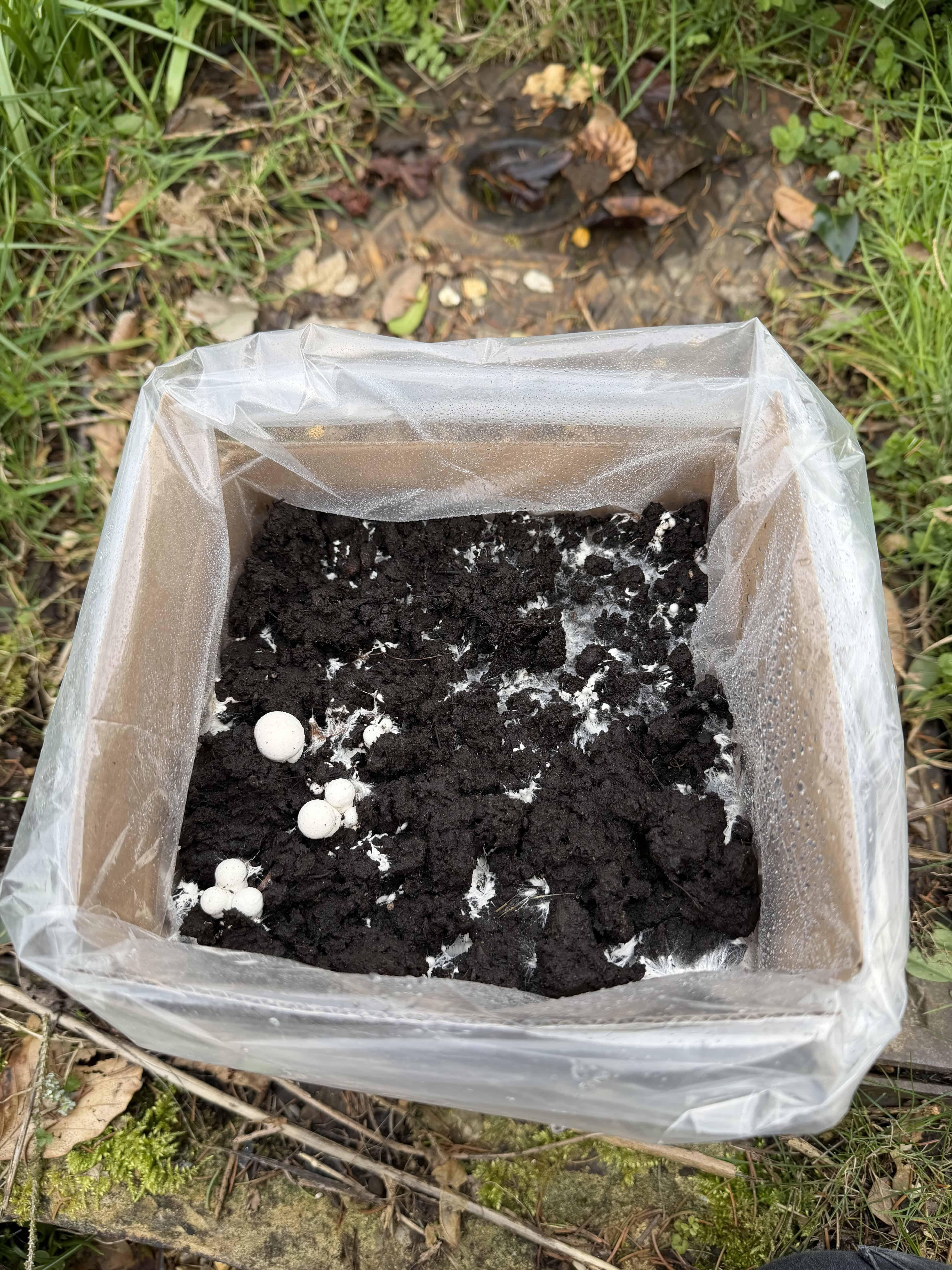
The surface should look lightly damp, not dry and not pooling with water
Fresh air exchange
Mushrooms need fresh air exchange (often shortened to FAE) to trigger and sustain fruiting. As mushrooms grow, they release carbon dioxide. If that CO2 builds up around the kit because the space is too enclosed, the mycelium cannot transition from vegetative growth to producing mushrooms. It will continue spreading across the surface as white fuzz instead of forming pins.
A kit that is suffocated simply cannot crop. This is one of the most common causes of delayed or failed fruiting. If your kit has thick white growth covering the surface but no pins, the growing environment is likely too enclosed. The overgrown mycelium guide explains what to do. Moving the kit to a room with natural air movement usually triggers pinning within a few days.
There is one important exception. Reishi mushrooms need higher CO2 levels to fruit properly. If you open a Reishi kit bag too early, the CO2 drops and the mushroom struggles to form its characteristic antler-like growth. Keep the bag sealed until the instructions tell you to open it. The kit is designed to manage its own CO2 environment inside the bag.
Draughts
Fresh air exchange is important, but direct draughts are a problem. A cold draught blowing across the kit dries the surface faster than misting can keep up with, causes temperature fluctuations around the block, and can stall pin formation entirely.
The difference between good airflow and a harmful draught is simple. Good airflow is gentle, ambient air movement in a room. A draught is a direct stream of cold or warm air hitting the kit, whether from an open window, a fan, an air conditioning unit, or a gap under a door. Place the kit in the room but away from the direct path of any draught.
The age of the kit
Not every kit leaves the farm at exactly the same stage. The mycelium is always fully colonised before dispatch, but the maturity of that colonisation can vary slightly depending on when the kit was produced and how busy the season is.
At the busiest times of year, particularly during the Christmas gifting season, kits may be dispatched slightly younger to ensure they have good shelf life on arrival and are suitable for gifting. A younger kit may take a few extra days to begin fruiting because the mycelium, while fully colonised, has not quite reached the point where it is ready to produce mushrooms on demand. This is completely normal and the kit will catch up once it settles into its growing environment at home.
Conversely, a kit that has been stored for several days before starting may fruit faster because the mycelium has continued to mature during storage. If you have stored a kit in the fridge or a cool room before opening, it may produce pins sooner than the typical timeline suggests.
The variety you are growing
Each mushroom species has its own natural growth speed, and no amount of perfect conditions will make a slow variety grow as fast as a quick one. Here is how the varieties compare.
| Variety | Typical first harvest | Notes |
|---|---|---|
| White Oyster | 7-10 days | Fastest variety. Responds quickly to humidity and fresh air. |
| Lion's Mane | 7-10 days | Different misting method. Spray paper towels, not the mushroom. |
| Shiitake | 7-10 days | Heavy first flush, typically around 1kg. Brown patches on the block are normal. |
| King Oyster | 7-10 days | Thick, meaty stems. Grows more slowly than standard oyster varieties. |
| Chestnut / White | 16-24 days | Longer because the topsoil casing needs 8 days to colonise first. |
| Pink Oyster | 7-10 days | Fast and vibrant. Prefers warmer conditions than other oyster varieties. |
What to do if your kit is taking longer than expected
If your kit has passed the typical timeline for its variety and you see no pins, work through this checklist before contacting support.
Check the temperature
Is the room between 14 and 21 degrees? Is it stable or does it swing widely between day and night? Move the kit if needed.
Check moisture levels
Is the surface damp? If dry, mist more. If pooling with water, stop misting for a day and let it dry. The surface should look lightly moist, not wet or dusty.
Check airflow
Is the kit in an open room or an enclosed space? Thick white overgrown mycelium with no pins means the kit needs more fresh air exchange. Is there a direct draught? Move the kit out of the draught path.
Check the variety timeline
Are you comparing against the right variety? Chestnut and white kits take 16 to 24 days, not 7 to 10. If you are within the normal range for your variety, give it more time.
Contact support
If conditions are right and you are past the expected timeline for your variety, contact the Merryhill Mushrooms support team with a photo of the kit, the room it is in, and what day you are on. The team can usually identify the issue quickly.
Choose Your Variety
Every Merryhill Mushrooms ready growing kit arrives fully colonised. Pick the variety that suits your timeline and taste.
Shop All Growing KitsFrequently asked questions
Why is my mushroom kit taking longer than expected?
The most common reasons are temperature outside the 14 to 21 degree range, low humidity from dry air or missed misting, poor airflow in an enclosed space, or comparing against the wrong variety timeline. Check each factor in order and adjust. Most kits respond within a few days of improved conditions.
Can I speed up my mushroom kit?
The best way to get timely results is to provide consistent conditions: stable temperature around 17 to 18 degrees, regular misting, good airflow, and indirect light. Trying to speed things up by adding heat or over-misting usually causes more problems than it solves. Patience and consistency beat intervention.
Does cold weather slow mushroom growth?
Yes. Cooler temperatures within the 14 to 21 degree range slow growth but usually produce firmer, denser mushrooms. Below 14 degrees, growth can stall significantly. If your home runs cold in winter, choose the warmest stable room for the kit rather than placing it near a radiator, which creates dry heat and temperature swings.
Why did my kit arrive and crop faster than expected?
A more mature kit will fruit faster because the mycelium is further along in its development. If your kit was produced during a quieter period or spent a day or two in transit, the mycelium may have matured enough to begin fruiting almost immediately once you open the box and provide the right conditions.
Why does my Reishi kit need the bag kept sealed?
Reishi mushrooms need higher CO2 levels to fruit properly, which is the opposite of most other varieties. The sealed bag creates the CO2-rich environment the mushroom requires. Opening the bag too early drops the CO2 and can stop the mushroom from forming. Follow the instructions and only open the bag when directed.
Related reading
Published by Merryhill Mushrooms
Sussex, UK | Six generations of mushroom growing excellence