


Outdoor Mushroom Log Growing Kits



Outdoor Mushroom Log Growing Kits
£8.00 each if ordering more than 2! (Same variety)Key takeaways
- An outdoor log kit is a bag of inoculated plugs and sealing wax you hammer into a freshly cut hardwood log to grow mushrooms outdoors for three to five years.
- Each kit holds 30 plugs, enough for a one metre log of 15 to 20cm diameter, one variety per log.
- Choose from seven varieties: Shiitake, Lion's Mane, White Oyster, Tarragon Oyster, Summer Oyster, Turkey Tail and Golden Enoki.
- Use hardwood only, such as oak, beech, birch, alder, ash or elm. Never softwood or conifer.
- Spring and autumn are the best times to plug, but it can be done year round, with extra watering in summer.
- Colonisation takes 12 to 18 months, then the log fruits in its season each year for three to five years.
- Plugs keep in the fridge for up to 3 months, so the kits make excellent gifts.
Choose from different species using the variety dropdown above.
Bulk Buy Discounts
| Quantity Purchased | Price |
|---|---|
| 2 + | £8.00 |
Send this to a friend
Outdoor Mushroom Log Growing Kits
What is in the kit
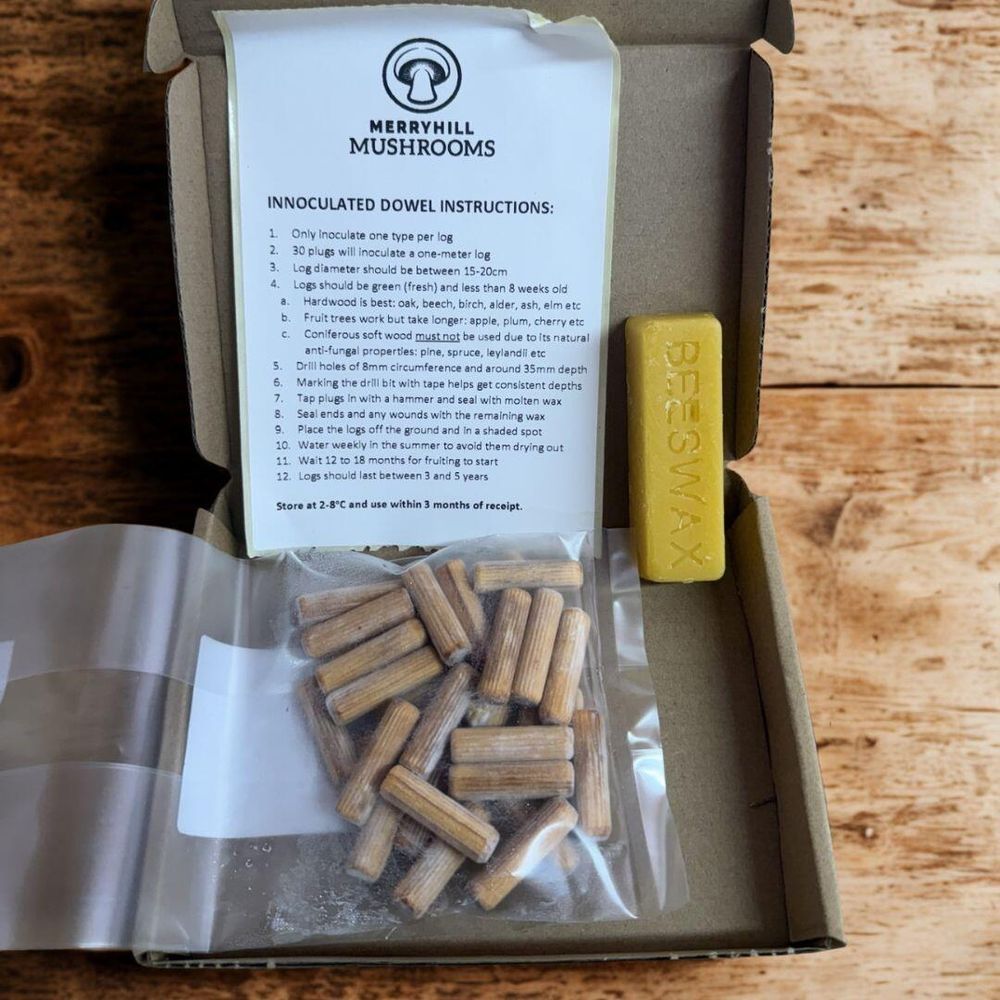
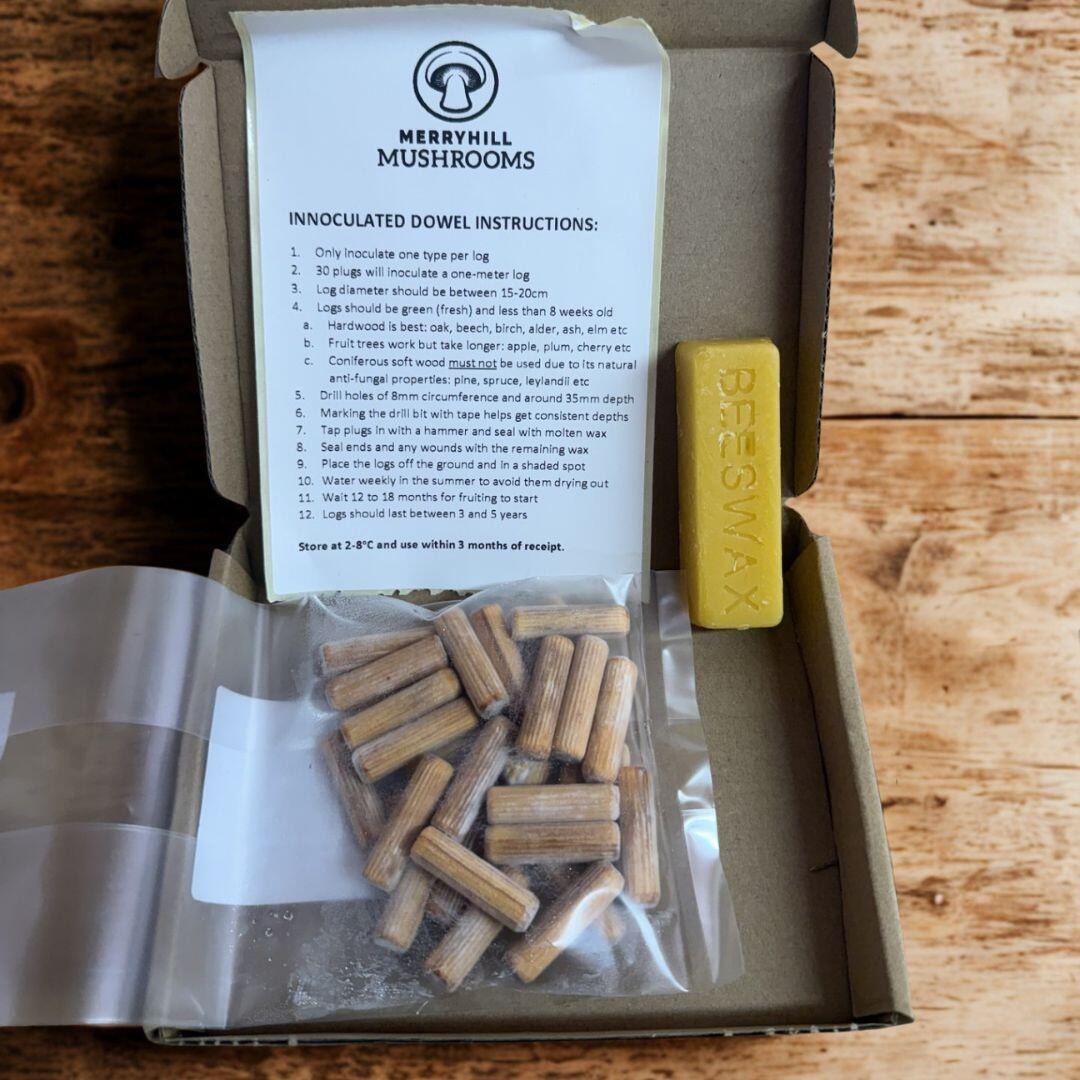
Every outdoor log growing kit includes:
- 30 inoculated wooden spawn plugs (single variety per kit)
- Beeswax to seal the holes and the cut ends of the log
- Full inoculation instructions
You will also need an electric drill, an 8mm drill bit, a mallet and something to melt the wax in. These are not supplied. Plugs should be refrigerated until you are ready to inoculate.
To store the kits before use / gifting, please store in the fridge for up to 3 months.
Why we choose these varieties for outdoor logs
Turkey Tail, Summer Oyster and Tarragon Oyster all occur naturally on British hardwoods, so growing them outdoors supports native fungal biodiversity rather than introducing exotic species. Shiitake is the long-standing classic for log growing and produces the heaviest crops. White Oyster is also very well suited to the British climate.
Choosing the right log
Logs should be freshly cut hardwood, between two and eight weeks old. Logs cut less than two weeks ago can still contain residual antifungal compounds that inhibit the spawn. Logs older than eight weeks risk hosting rival mycelium that will outcompete your plugs.
Best: Hardwoods such as oak, beech, birch, alder, ash and elm.
Acceptable: Fruit woods such as apple, plum and cherry. These will fruit, but more slowly.
Avoid: Softwoods, pines and conifers. Their natural antifungal resins prevent colonisation.
Oak is the slowest to colonise but the longest lasting, while birch and alder take faster and break down sooner.
Inoculate one variety per log only. 30 plugs are enough for a one metre log of 15 to 20cm diameter. Anything thicker becomes hard to handle and harder to colonise evenly.
Not every log will do, so it is worth knowing which logs are best for growing mushrooms in the UK before you cut.
How outdoor log growing works
Drill holes in a diamond pattern along the log, hammer in the spawn plugs, then seal each hole and both cut ends with melted beeswax to lock in moisture. Stand the log in a shaded, sheltered spot and leave it. Colonisation takes 12 to 18 months, after which the log will fruit naturally after rainfall for three to five years with almost no ongoing care.
Read our full step by step guide: how to grow mushrooms on outdoor logs.
When to plug your log and when it fruits
Spring and autumn are the best times to plug a log, but it can be done all year round. Summer works too, as long as you water more often to stop the freshly drilled log drying out. Whichever season you plug, the log takes 12 to 18 months to colonise before its first crop, then fruits year after year for three to five years, most often as the cooler, damper weather arrives.
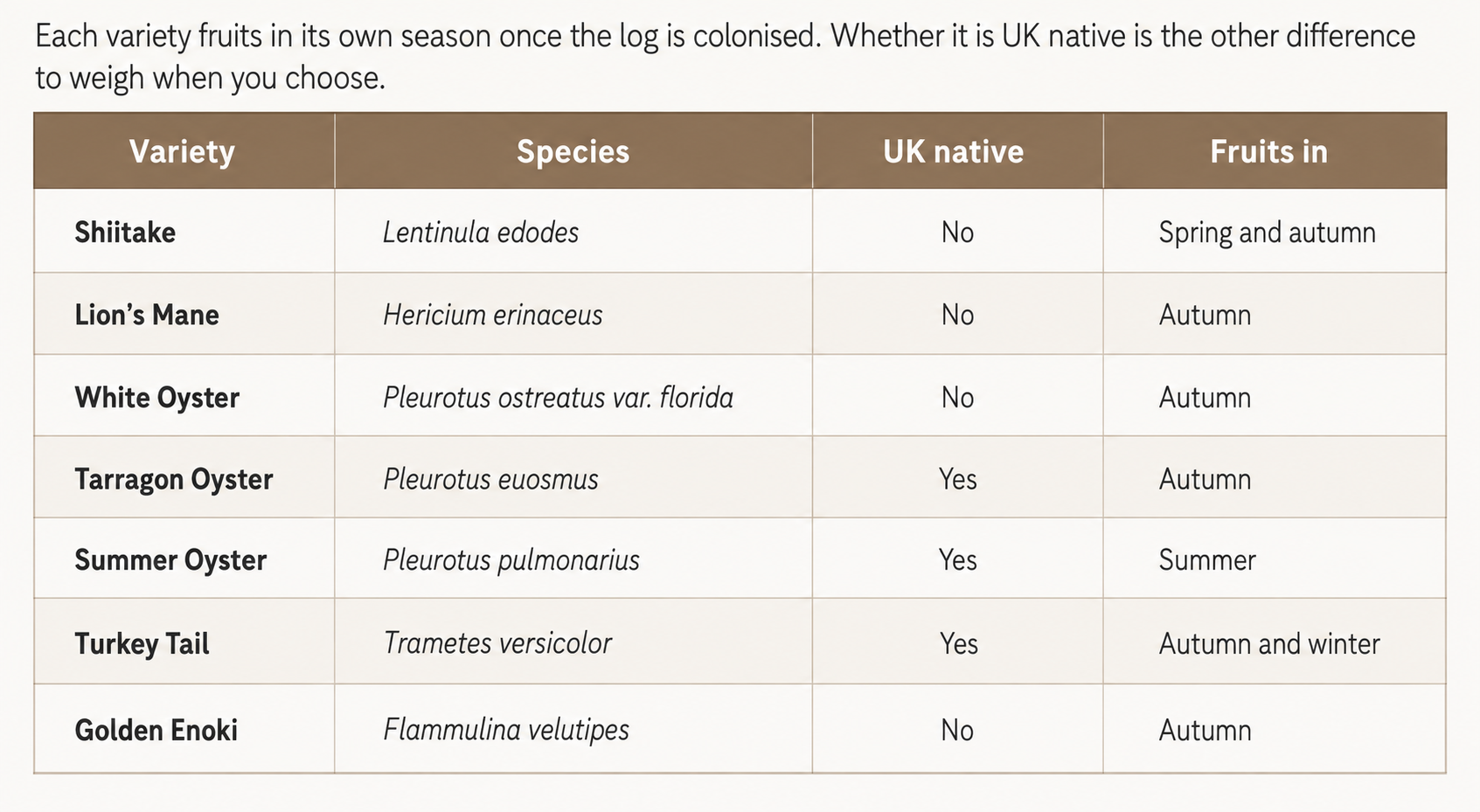
Each variety fruits in its own season once the log is colonised. Whether it is UK native is the other difference to weigh when you choose.
How to inoculate your log, step by step
The method is old, simple and hard to get badly wrong.
- Drill. Fit the 8mm bit and drill straight in, deep enough that a plug sits just below the bark. Masking tape wrapped round the bit, or a depth stop, keeps every hole the same.
- Set out the pattern. Work in rows along the length of the log, staggering each row so the holes fall in a diamond rather than a grid. Even coverage lets the mycelium meet itself from every direction and take the whole log.
- Hammer. Tap each plug home with a mallet until it sits flush or a fraction below. If a plug spins loose the hole was drilled too wide, so drill a fresh one alongside.
- Seal. Melt the beeswax and dab it over every plug, then wax both cut ends. This holds moisture in and keeps other spores, insects and rain out while the mycelium travels. Skipping it is the second most common reason a log fails, after seasoned wood.
- Label. Scratch the variety and date into the wax. In fourteen months you will not remember. Work through the whole kit in one session.
Where to keep your log
Shade, deep shade if you have it: under a hedge, behind a shed on the north side, or beneath a tree canopy. Direct sun is the enemy, because a dry log is a dead log.
Stack logs horizontally on bearers to keep them off bare soil, or stand them upright with the base buried so they wick moisture from the ground. Upright suits smaller gardens, stacking suits larger logs and several at once.
Rain does most of the watering. In a dry spell of more than a fortnight, soak the log with a hose or leave it in a water butt overnight. Aim for damp, not waterlogged, as a log sat in a puddle rots the wrong way.
What to expect: the colonisation timeline
Oak sits at the long end of the 12 to 18 month window, birch and alder the short. For the first few months nothing visible happens. Around six months in, scratch a little wax off a plug and you may see white mycelium spreading into the wood.
Later, white patches show at the sawn ends, the sign most growers wait for, as the mycelium has run the full length. The bark loosens and the ends pale. Then it fruits, usually after rain, in the season shown for your variety above. Early flushes are small and build over the seasons that follow.
Worked example: a birch log, Shiitake, early spring
Sam has a birch limb from a tree taken down in February, about a metre long and just liftable. He orders a Shiitake log kit and keeps the plugs in the fridge. Mid March, on a dry Saturday, he drills the log with an 8mm bit in staggered rows, taps 30 plugs home with a mallet, then seals every plug and both cut ends with beeswax and scratches "Shiitake, March" into the wax. The log goes behind his shed, upright with its base in the soil, shaded all day. In a dry July he soaks it twice with the hose. Nothing happens for a year. The following spring he scratches at a plug and finds white threads in the wood, and by the autumn after that, roughly eighteen months from drilling, white shows at the sawn ends. After a wet October week the first shiitake push through the bark, and he picks them that weekend. Meanwhile a Shiitake ready growing kit on the windowsill fed him while the wood worked.
Worked example: three Turkey Tail kits into oak rounds in autumn
Ruth has three oak rounds from a felled garden tree, each about knee height, and she is not in a hurry. Ordering three kits of the same variety, she pays £8.00 each rather than £10.00. Early October she inoculates all three, 90 plugs waxed and labelled, then stands them under a beech hedge on the shady side of the garden, half buried in leaf litter. Year one, nothing. She checks in spring, again in autumn, and leaves them alone. Late in the second summer the cut faces have paled and the bark is loosening. That autumn, after a wet spell, the first small fans appear low on the rounds, banded in brown, cream and grey, in overlapping tiers the way Trametes versicolor grows on dead hardwood in any British wood. Oak is slow, but oak also lasts, and her rounds keep producing every damp season.
Which of the seven varieties should you choose?
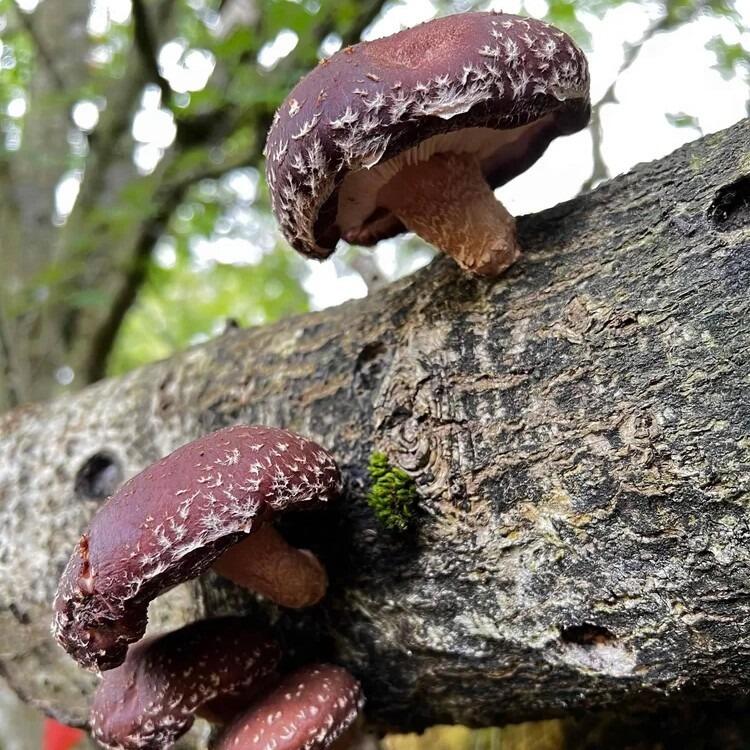
Shiitake (Lentinula edodes). The classic log species and the most widely cultivated mushroom on logs worldwide. Meaty and savoury, it dries beautifully and gives the heaviest crops, fruiting in spring and autumn. If you only ever grow one log, grow this. If you want the detail, read our full guide to the Shiitake log growing kit.
White Oyster (Pleurotus ostreatus var. florida). Fast, forgiving and generous, and well suited to the British climate. The most likely of the seven to reward a first attempt.
Summer Oyster (Native) (Pleurotus pulmonarius). A UK native oyster cropping through the warmer months, filling the summer gap when other logs are quiet.
Tarragon Oyster (Native) (Pleurotus euosmus). Also UK native, with a distinctive aniseed note. It crops more slowly than the other oysters, which gives the flavour time to develop its depth.
Lion's Mane (Hericium erinaceus). Unmistakable white cascades. Slower and fussier than the oysters and happiest on beech or oak. One for the grower who wants what nobody else has.
Golden Enoki (Flammulina velutipes). Clusters of small golden caps that favour cooler weather, cropping in autumn as the season turns.
Turkey Tail (UK Native) (Trametes versicolor). Our newest variety, a native bracket fungus of dead and dying hardwood, fan shaped with concentric colour bands, showing through autumn and winter. Turkey Tail is the one variety here people grow for the brew rather than the plate: too tough and leathery to eat as a vegetable, it is dried and simmered into teas and decoctions, with a long history of traditional use, particularly in East Asia. If you want the detail, read our full guide to the Turkey Tail log growing kit.
Log kit or ready growing kit?
A log kit is a project. It costs little, needs a log and a drill, takes 12 to 18 months, then feeds you for three to five years. It suits gardeners, allotment holders and anyone who wants a permanent crop in the corner of the garden.
A ready growing kit arrives already colonised. You cut the holes and mist twice daily, and oyster varieties typically crop in 7 to 10 days, with 2 to 3 harvests over 3 to 4 weeks. It suits flats, impatient cooks and children. Most people are best served by both: put the logs out, then keep a ready growing kit indoors while the wood does its slow work.
Log kits make excellent gifts
Because the plugs keep in the fridge for two to three months, you can buy in October for Christmas, or in spring for a summer birthday, without the gift going off. A log kit also gives someone a project rather than an object, and it will still be producing mushrooms years after most presents are forgotten. A hand written gift note can be added for £0.50.
Start your outdoor log this season
Pick your variety above and order plugs, beeswax and full instructions. Kits start at £10.00, or £8.00 each when you order more than 2 of the same variety.
Buy a mushroom growing kitOutdoor mushroom logs: frequently asked questions
What mushrooms grow on logs?
Wood-loving species such as Shiitake, Lion's Mane, oyster mushrooms (White, Tarragon, Summer), Reishi, Maitake and Golden Enoki all grow on hardwood logs. Our outdoor kits cover seven: Shiitake, Lion's Mane, White Oyster, Tarragon Oyster, Summer Oyster, Turkey Tail and Golden Enoki.
Can you grow mushrooms on pine logs?
No. Pine and other softwoods contain resins and acids that prevent gourmet mushroom species from colonising, and the same goes for old Christmas trees. Stick to hardwoods such as oak, beech, birch, alder, ash or elm, or a fruit wood such as apple, plum or cherry. If you are offered mixed firewood, ask which species it came from before committing a kit to it.
How long do mushroom logs last?
A well inoculated hardwood log will fruit for three to five years on average. Larger or denser logs (oak in particular) can keep producing for longer. The log will gradually break down as the mycelium consumes it.
How many plugs per log?
30 plugs are enough for a one metre log of 15 to 20cm diameter, drilled in a diamond pattern with five or six rows around the log. Use a second kit for anything much larger, and note that ordering more than 2 of the same variety brings the price down to £8.00 each. Always inoculate one variety per log, as spreading 30 plugs thinly over a big log slows colonisation and leaves competitor fungi room to move in.
How do I inoculate a mushroom log?
Drill 8mm holes around 50mm deep in a diamond pattern, hammer in the spawn plugs flush with the bark, then seal every hole and both cut ends of the log with melted beeswax. Stand the log in a shaded spot. The full method is in our outdoor log growing guide.
When is the best time to inoculate?
Spring and autumn are the best windows, but plugs can be used at any point in the year. In summer, water the log more often so it does not dry out before the mycelium establishes. Only ever inoculate a freshly cut log, and refrigerate the kit until you are ready to start.
When will I get the biggest crop?
Not from the first flush. Early fruitings tend to be small because the mycelium is still spreading. Yields build over the seasons that follow, then tail off in the final year as the wood breaks down. Across three to five years a log gives far more than a single indoor kit, just spread much more thinly.
Nothing has appeared after a year. Have I failed?
Almost certainly not. Colonisation takes 12 to 18 months, so a year is still inside the window, and oak is slow. Check the sawn ends for white patches, and scratch a little wax off a plug to look for white threads running into the wood. If you find mycelium, the log is working. A log that has dried out completely, with bark shedding in sheets, is a different problem.
There is mould on the bark. Should I worry?
Usually not. Logs live outdoors, so algae, surface moulds and small patches of other fungi are normal on wet bark. What matters is inside the wood. Worry only if a competing fungus is fruiting in quantity from the log itself, particularly from the cut ends, as that suggests something else colonised the wood first, which nearly always means the log was not freshly cut.
My log has dried out. Can I save it?
Sometimes. Submerge it in a water butt, trug or paddling pool for a full day, then move it somewhere shadier. Mycelium can sit out a dry spell dormant and pick back up when moisture returns. What it cannot survive is drying out again and again through a season, so if that keeps happening the siting is wrong rather than the kit.
How long can I keep the plugs before using them?
Up to 3 months in the fridge. Keep them in their packaging, on a shelf rather than in the door, away from anything strong smelling. That window is why these kits work as presents, as you can order well ahead of the occasion and the recipient still receives live spawn. Once the plugs come out of the fridge, inoculate the same day.
Can I grow Turkey Tail if I have never grown anything before?
Yes. Turkey Tail colonises hardwood readily and asks very little once the log sits in shade and stays damp. Remember it is a tough, leathery bracket fungus rather than a tender culinary mushroom, so it is traditionally prepared as a tea or decoction rather than fried in butter. If you want something to cook with on your first log, choose Shiitake or White Oyster and add Turkey Tail as a second.




[[CONTENT]]